
Join Our JEE Preparation Group
Prep with like-minded aspirants; Get access to free daily tests and study material.
Sign in
Please select an account to continue using cracku.in
↓ →
Join Our JEE Preparation Group
Prep with like-minded aspirants; Get access to free daily tests and study material.
The center of mass of a thin rectangular plate (fig - x) with sides of length a and b, whose mass per unit area $$(\sigma)$$ varies as $$\sigma = \frac{\sigma_{\circ}x}{ab}$$ (where $$\sigma_{\circ}$$ is a constant), would be
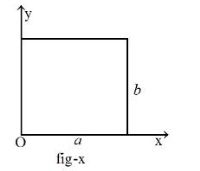
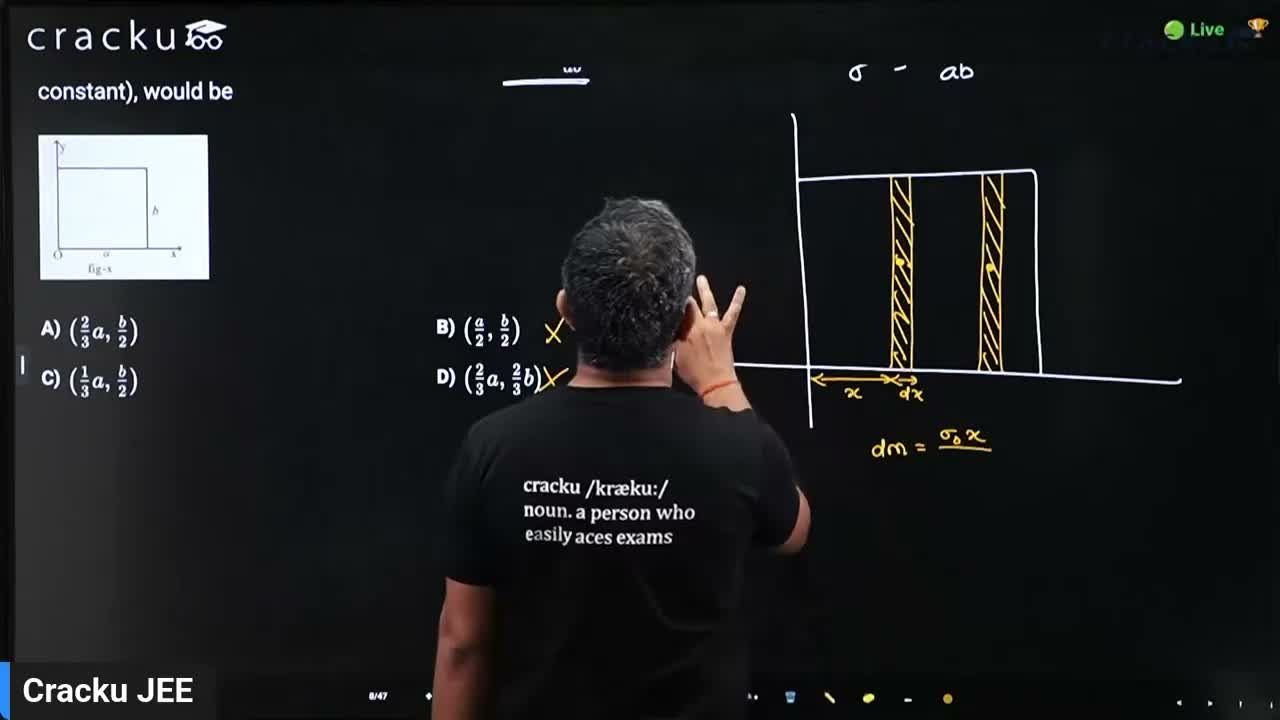
$$The\ mass\ per\ unit\ area\ is\ \sigma=\frac{\sigma_0x}{ab}.\ We\ integrate\ over\ the\ area\ ofthe\ plate\ (x\in[0,a],\ y\in[0,b]):$$
$$M = \int_{0}^{a} \int_{0}^{b} \sigma \, dy \, dx = \int_{0}^{a} \int_{0}^{b} \frac{\sigma_0 x}{ab} \, dy \, dx$$
$$M = \frac{\sigma_0}{ab} \left[ \frac{x^2}{2} \right]_0^a \left[ y \right]_0^b = \frac{\sigma_0}{ab} \left( \frac{a^2}{2} \right) (b) = \frac{\sigma_0 a}{2}$$
X-coordinate of Center of Mass:
$$x_{cm} = \frac{1}{M} \int \int x \sigma \, dA$$
$$x_{cm} = \frac{1}{M} \int_{0}^{a} \int_{0}^{b} x \left( \frac{\sigma_0 x}{ab} \right) \, dy \, dx = \frac{1}{M} \frac{\sigma_0}{ab} \int_{0}^{a} x^2 \, dx \int_{0}^{b} dy$$
$$x_{cm} = \frac{2}{\sigma_0 a} \cdot \frac{\sigma_0}{ab} \left( \frac{a^3}{3} \right) (b) = \frac{2}{\sigma_0 a} \cdot \frac{\sigma_0 a^2}{3} = \frac{2}{3}a$$
Y-coordinate of Center of Mass:
$$Since\ the\ density\ \sigma\ depends\ only\ on\ x$$
the mass is distributed uniformly in the y-direction for any given x. Therefore: $$y_{cm}=\frac{b}{2}$$
The center of mass is at: $$(x_{cm},y_{cm})=\left(\frac{2}{3}a,\frac{b}{2}\right)$$
Was this solution helpful?
Click on the Email ☝️ to Watch the Video Solution
Create a FREE account and get:
_1.webp)

Educational materials for JEE preparation

Ask our AI anything

AI can make mistakes. Please verify important information.
AI can make mistakes. Please verify important information.
