
Join Our JEE Preparation Group
Prep with like-minded aspirants; Get access to free daily tests and study material.
Sign in
Please select an account to continue using cracku.in
↓ →
Join Our JEE Preparation Group
Prep with like-minded aspirants; Get access to free daily tests and study material.
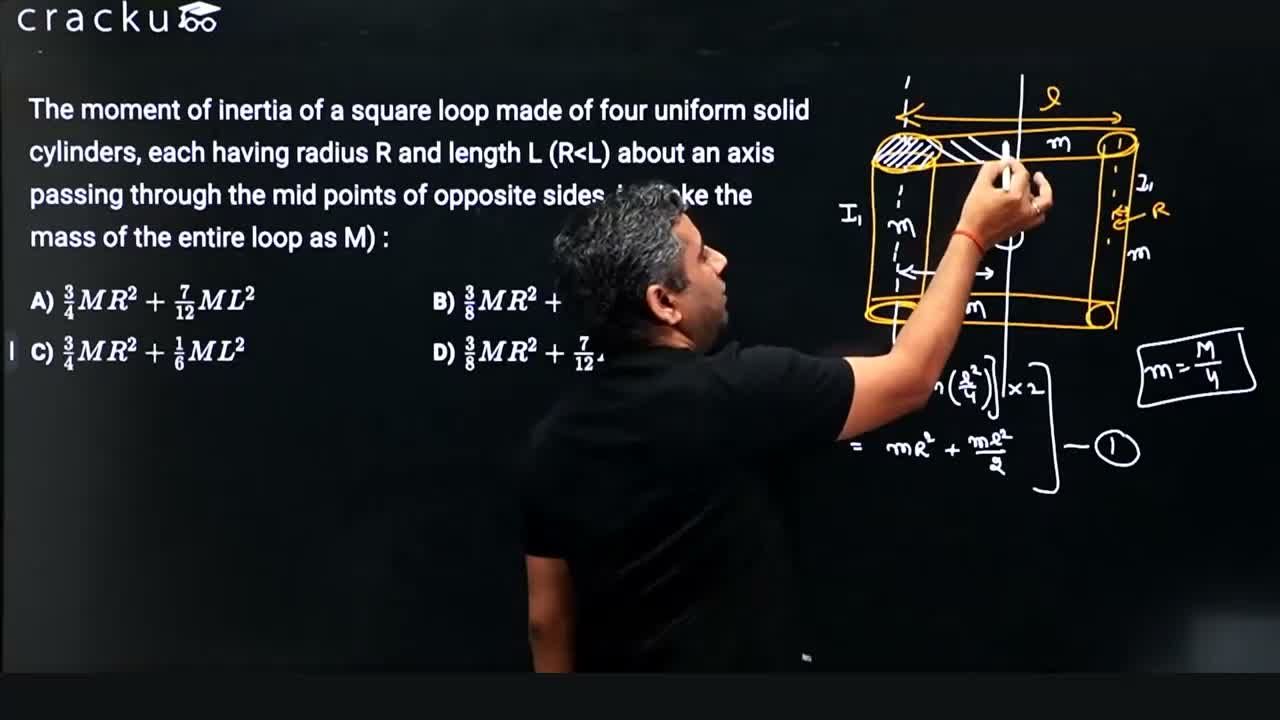
The moment of inertia of a square loop made of four uniform solid cylinders, each having radius R and length L (R<L) about an axis passing through the mid points of opposite sides, is (Take the mass of the entire loop as M) :
Let the mass of each cylinder be $$m = \frac{M}{4}$$.
The moment of inertia of a solid cylinder of mass $$m$$, radius $$R$$ and length $$L$$ about a diameter of its circular cross section (axis through centre perpendicular to its length) is given by the formula $$I_{\diameter} = \frac{1}{4}mR^2 + \frac{1}{12}mL^2$$ $$-(1)$$
The two vertical rods (left and right sides) have their midpoints on the rotation axis and for each the axis is a diameter of its cross section. Moment of inertia of one vertical rod about the given axis is $$I_{\text{v,1}} = \frac{1}{4}mR^2 + \frac{1}{12}mL^2$$. For two vertical rods, $$I_{\text{vertical}} = 2\,I_{\text{v,1}} = \frac{1}{2}mR^2 + \frac{1}{6}mL^2$$ $$-(2)$$
The moment of inertia of a solid cylinder of mass $$m$$ and radius $$R$$ about its central (longitudinal) axis is $$I_{\text{long}} = \frac{1}{2}mR^2$$ $$-(3)$$
The top and bottom rods are horizontal, parallel to the rotation axis, and at a perpendicular distance $$\frac{L}{2}$$ from it. Using the parallel axis theorem for one such rod: $$I_{\text{h,1}} = I_{\text{long}} + m\Bigl(\frac{L}{2}\Bigr)^2 = \frac{1}{2}mR^2 + \frac{1}{4}mL^2$$ $$-(4)$$
For both horizontal rods, $$I_{\text{horizontal}} = 2\,I_{\text{h,1}} = mR^2 + \frac{1}{2}mL^2$$ $$-(5)$$
The total moment of inertia of the square loop about the given axis is $$I = I_{\text{vertical}} + I_{\text{horizontal}} = \Bigl(\frac{1}{2}mR^2 + \frac{1}{6}mL^2\Bigr) + \Bigl(mR^2 + \frac{1}{2}mL^2\Bigr)\,. $$ Substituting $$m = \frac{M}{4}$$ gives $$I = \Bigl(\frac{1}{2}\cdot\frac{M}{4}R^2 + \frac{1}{6}\cdot\frac{M}{4}L^2\Bigr) + \Bigl(\frac{M}{4}R^2 + \frac{1}{2}\cdot\frac{M}{4}L^2\Bigr)$$ $$= \frac{M}{8}R^2 + \frac{M}{24}L^2 + \frac{M}{4}R^2 + \frac{M}{8}L^2 = \frac{3M}{8}R^2 + \frac{M}{6}L^2\,. $$
Therefore, the required moment of inertia is $$\displaystyle \frac{3}{8}MR^2 + \frac{1}{6}ML^2\,, $$ which corresponds to Option B.
Was this solution helpful?
Click on the Email ☝️ to Watch the Video Solution
Create a FREE account and get:
_1.webp)

Educational materials for JEE preparation

Ask our AI anything

AI can make mistakes. Please verify important information.
AI can make mistakes. Please verify important information.
