
Join Our JEE Preparation Group
Prep with like-minded aspirants; Get access to free daily tests and study material.
Sign in
Please select an account to continue using cracku.in
↓ →
Join Our JEE Preparation Group
Prep with like-minded aspirants; Get access to free daily tests and study material.
In hydrogen atom spectrum, (R ➔ Rydberg's constant)
A. the maximum wavelength of the radiation of Lyman series is $$\frac{4}{3R}$$
B. the Balmer series lies in the visible region of the spectrum
C. the minimum wavelength of the radiation of Paschen series is $$\frac{9}{R}$$
D. the minimum wavelength of Lyman series is $$\frac{5}{4R}$$
Choose the correct answer from the options given below :
We need to verify which statements about the hydrogen atom spectrum are correct.
Key Formula: The wavelength of spectral lines is given by:
$$\frac{1}{\lambda} = R\left(\frac{1}{n_1^2} - \frac{1}{n_2^2}\right)$$
where $$R$$ is Rydberg's constant, $$n_1$$ is the lower level, and $$n_2$$ is the upper level.
Statement A: The maximum wavelength of Lyman series is $$\frac{4}{3R}$$.
The Lyman series has $$n_1 = 1$$. Maximum wavelength corresponds to minimum energy transition ($$n_2 = 2$$):
$$\frac{1}{\lambda_{max}} = R\left(\frac{1}{1^2} - \frac{1}{2^2}\right) = R \times \frac{3}{4}$$
$$\lambda_{max} = \frac{4}{3R}$$ Statement A is CORRECT.
Statement B: The Balmer series lies in the visible region of the spectrum.
The Balmer series has $$n_1 = 2$$. Its wavelengths range from 364.6 nm (series limit) to 656.3 nm, which falls in the visible region (380-700 nm). Statement B is CORRECT.
Statement C: The minimum wavelength of Paschen series is $$\frac{9}{R}$$.
The Paschen series has $$n_1 = 3$$. Minimum wavelength corresponds to the series limit ($$n_2 \to \infty$$):
$$\frac{1}{\lambda_{min}} = R\left(\frac{1}{3^2} - 0\right) = \frac{R}{9}$$
$$\lambda_{min} = \frac{9}{R}$$ Statement C is CORRECT.
Statement D: The minimum wavelength of Lyman series is $$\frac{5}{4R}$$.
The minimum wavelength of Lyman series corresponds to $$n_2 \to \infty$$:
$$\frac{1}{\lambda_{min}} = R\left(\frac{1}{1^2} - 0\right) = R$$
$$\lambda_{min} = \frac{1}{R}$$
This is NOT $$\frac{5}{4R}$$. Statement D is INCORRECT.
The correct statements are A, B, and C.
The correct answer is Option 3: A, B and C Only.
Was this solution helpful?
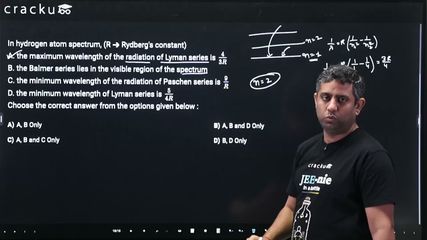
Click on the Email ☝️ to Watch the Video Solution
Create a FREE account and get:
_1.webp)

Educational materials for JEE preparation

Ask our AI anything

AI can make mistakes. Please verify important information.
AI can make mistakes. Please verify important information.
