
Join Our JEE Preparation Group
Prep with like-minded aspirants; Get access to free daily tests and study material.
Sign in
Please select an account to continue using cracku.in
↓ →
Join Our JEE Preparation Group
Prep with like-minded aspirants; Get access to free daily tests and study material.
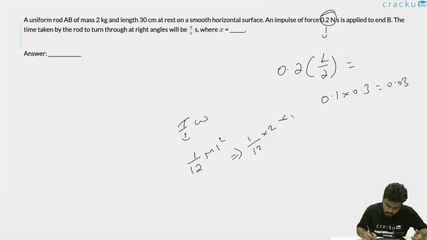
A uniform rod AB of mass 2 kg and length 30 cm at rest on a smooth horizontal surface. An impulse of force 0.2 N s is applied to end B. The time taken by the rod to turn through at right angles will be $$\frac{\pi}{x}$$ s, where $$x$$ = ______.
Correct Answer: 4
A uniform rod AB of mass 2 kg and length 30 cm (0.3 m) is initially at rest on a smooth horizontal surface. When an impulse of 0.2 N s is applied horizontally at end B, the rod acquires both linear and angular motion, and we seek the time required for it to rotate by 90° (π/2 radians), expressed in the form π/x seconds.
The impulse-momentum theorem gives the change in linear momentum of the rod’s center of mass according to $$J = M \cdot v_{\text{cm}}$$, where $$J = 0.2$$ N s and $$M = 2$$ kg. Substituting the values, $$0.2 = 2 \cdot v_{\text{cm}}$$, so $$v_{\text{cm}} = \frac{0.2}{2} = 0.1\ \text{m/s}$$. Thus the center of mass moves at 0.1 m/s in the direction of the impulse.
The same impulse also imparts angular momentum about the center of mass. The perpendicular distance from the center of mass to B is $$L/2 = 0.15$$ m, so the angular impulse is $$J \cdot \frac{L}{2} = 0.2 \cdot 0.15 = 0.03\ \text{N s m}$$. The moment of inertia of a uniform rod about its center of mass is $$I = \frac{M L^2}{12} = \frac{2 \cdot (0.3)^2}{12} = \frac{2 \cdot 0.09}{12} = \frac{0.18}{12} = 0.015\ \text{kg m}^2\,. $$ Equating angular impulse to the change in angular momentum via $$J \cdot \frac{L}{2} = I \cdot \omega$$ gives $$0.03 = 0.015 \cdot \omega$$ and hence $$\omega = \frac{0.03}{0.015} = 2\ \text{rad/s}\,.$$
Since no external torques act after the impulse, the rotation proceeds at constant angular velocity $$\omega = 2\ \text{rad/s}$$. The angle rotated satisfies $$\theta = \omega \cdot t$$, so $$\frac{\pi}{2} = 2 \cdot t$$ and thus $$t = \frac{\pi}{4}\ \text{seconds}\,, $$ giving $$x = 4$$.
The translation of the center of mass does not affect the rotation angle, as the angular motion is independent; hence the time taken for the rod to rotate by 90° is $$\pi/4$$ seconds.
Was this solution helpful?
Click on the Email ☝️ to Watch the Video Solution
Create a FREE account and get:
_1.webp)

Educational materials for JEE preparation

Ask our AI anything

AI can make mistakes. Please verify important information.
AI can make mistakes. Please verify important information.
