
Join Our JEE Preparation Group
Prep with like-minded aspirants; Get access to free daily tests and study material.
Sign in
Please select an account to continue using cracku.in
↓ →
Join Our JEE Preparation Group
Prep with like-minded aspirants; Get access to free daily tests and study material.
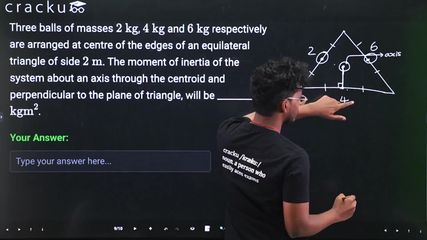
Three balls of masses $$2 \text{ kg}$$, $$4 \text{ kg}$$ and $$6 \text{ kg}$$ respectively are arranged at centre of the edges of an equilateral triangle of side $$2 \text{ m}$$. The moment of inertia of the system about an axis through the centroid and perpendicular to the plane of triangle, will be ___________ $$\text{kgm}^2$$.
Correct Answer: 4
We need to find the moment of inertia of three balls placed at the midpoints of the edges of an equilateral triangle, about an axis through the centroid and perpendicular to the plane.
First, recall that the moment of inertia of a system of point masses about an axis is given by $$I = \sum m_i r_i^2$$, where $$r_i$$ is the perpendicular distance of each mass from the axis of rotation.
To determine that distance, note that in an equilateral triangle of side $$a$$, the centroid divides each median in a 2:1 ratio measured from the vertex. Since the median has length $$\frac{\sqrt{3}}{2}a$$, the distance from the centroid to a vertex is $$\frac{2}{3}\times\frac{\sqrt{3}}{2}a = \frac{a}{\sqrt{3}}$$, while the distance from the centroid to the midpoint of a side is $$\frac{1}{3}\times\frac{\sqrt{3}}{2}a = \frac{a}{2\sqrt{3}} = \frac{a\sqrt{3}}{6}$$.
Substituting $$a = 2\text{ m}$$ into the latter expression gives $$r = \frac{2}{2\sqrt{3}} = \frac{1}{\sqrt{3}}\text{ m}$$.
Because the centroid is equidistant from all three edges, each mass lies at the same distance $$r = \frac{1}{\sqrt{3}}$$ from the axis. Squaring this distance yields $$r^2 = \left(\frac{1}{\sqrt{3}}\right)^2 = \frac{1}{3}\,\text{m}^2.$$
Therefore, the total moment of inertia can be written as $$I = m_1r^2 + m_2r^2 + m_3r^2 = (m_1 + m_2 + m_3)\,r^2$$. Substituting the given masses and $$r^2$$ results in $$I = (2 + 4 + 6)\times\frac{1}{3} = 12\times\frac{1}{3} = 4\,\text{kg m}^2.$$
The correct answer is 4 kg m$$^2$$.
Was this solution helpful?
Click on the Email ☝️ to Watch the Video Solution
Create a FREE account and get:
_1.webp)

Educational materials for JEE preparation

Ask our AI anything

AI can make mistakes. Please verify important information.
AI can make mistakes. Please verify important information.
