
Join Our JEE Preparation Group
Prep with like-minded aspirants; Get access to free daily tests and study material.
Sign in
Please select an account to continue using cracku.in
↓ →
Join Our JEE Preparation Group
Prep with like-minded aspirants; Get access to free daily tests and study material.
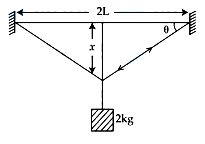
A wire of cross sectional area A, modulus of elasticity $$2 \times 10^{11} \text{ Nm}^{-2}$$ and length $$2 \text{ m}$$ is stretched between two vertical rigid supports. When a mass of $$2 \text{ kg}$$ is suspended at the middle, it sags lower from its original position making an angle $$\theta = \frac{1}{100}$$ radian on the points of support. The value of A is ___________ $$\times 10^{-4} \text{ m}^2$$ (consider $$x << L$$). (given : $$g = 10 \text{ m/s}^2$$)
Correct Answer: 1
When the mass $$m$$ is suspended, the vertical components of the tension ($$T$$) in the two halves of the wire balance the weight: $$2T \sin \theta = mg$$
For small angles ($$\theta = 1/100$$ rad), we use the approximation $$\sin \theta \approx \theta$$
$$2T\theta = mg \implies T = \frac{mg}{2\theta}$$
The original length of half the wire is $$L$$. The new length $$L'$$ is $$L' = \frac{L}{\cos \theta}$$
$$\text{Strain} = \frac{L' - L}{L} = \frac{1}{\cos \theta} - 1$$
Using the small angle approximation $$\cos \theta \approx 1 - \frac{\theta^2}{2}$$:
$$\text{Strain} \approx \left(1 + \frac{\theta^2}{2}\right) - 1 = \frac{\theta^2}{2}$$
$$Y = \frac{T / A}{\theta^2 / 2} = \frac{2T}{A\theta^2}$$
$$Y = \frac{2(mg / 2\theta)}{A\theta^2} = \frac{mg}{A\theta^3}$$
$$A = \frac{mg}{Y\theta^3}$$
$$A = \frac{2 \times 10}{(2 \times 10^{11}) \times (10^{-2})^3}$$
$$A = \frac{20}{2 \times 10^{11} \times 10^{-6}} = \frac{10}{10^5} = 1 \times 10^{-4} \text{ m}^2$$
The answer is 1.
Was this solution helpful?
Create a FREE account and get:
_1.webp)

Educational materials for JEE preparation

Ask our AI anything

AI can make mistakes. Please verify important information.
AI can make mistakes. Please verify important information.
