
Join Our JEE Preparation Group
Prep with like-minded aspirants; Get access to free daily tests and study material.
Sign in
Please select an account to continue using cracku.in
↓ →
Join Our JEE Preparation Group
Prep with like-minded aspirants; Get access to free daily tests and study material.
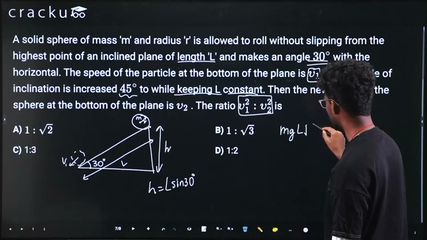
A solid sphere of mass 'm' and radius 'r' is allowed to roll without slipping from the highest point of an inclined plane of length 'L' and makes an angle $$30^{\circ}$$ with the horizontal. The speed of the particle at the bottom of the plane is $$\upsilon_{1}$$ . If the angle of inclination is increased $$45^{\circ}$$ to while keeping L constant. Then the new speed of the sphere at the bottom of the plane is $$\upsilon_{2}$$ . The ratio $$\upsilon_1^2:\upsilon_2^2$$ is
For a solid sphere rolling without slipping down an inclined plane of length $$L$$, energy conservation relates the loss of gravitational potential energy to the sum of translational and rotational kinetic energies. The moment of inertia of a solid sphere is $$I = \frac{2}{5}mr^2$$.
Specifically, if the sphere descends a vertical height $$h$$, then $$mgh = \frac{1}{2}mv^2 + \frac{1}{2}I\omega^2 = \frac{1}{2}mv^2\left(1 + \frac{I}{mr^2}\right) = \frac{1}{2}mv^2\left(1 + \frac{2}{5}\right) = \frac{7}{10}mv^2,$$ leading to $$v^2 = \frac{10gh}{7} = \frac{10g \cdot L\sin\theta}{7}.$$
For an incline at $$30°$$, this gives $$v_1^2 = \frac{10gL\sin 30°}{7} = \frac{10gL}{7} \cdot \frac{1}{2},$$ and for $$45°$$, $$v_2^2 = \frac{10gL\sin 45°}{7} = \frac{10gL}{7} \cdot \frac{1}{\sqrt{2}}.$$
Hence the ratio of the squared speeds is $$\frac{v_1^2}{v_2^2} = \frac{\sin 30°}{\sin 45°} = \frac{1/2}{1/\sqrt{2}} = \frac{\sqrt{2}}{2} = \frac{1}{\sqrt{2}},$$ so that $$v_1^2 : v_2^2 = 1 : \sqrt{2}$$. Therefore, the correct answer is Option 1: $$1:\sqrt{2}$$.
Was this solution helpful?
Click on the Email ☝️ to Watch the Video Solution
Create a FREE account and get:
_1.webp)

Educational materials for JEE preparation

Ask our AI anything

AI can make mistakes. Please verify important information.
AI can make mistakes. Please verify important information.
