
Join Our JEE Preparation Group
Prep with like-minded aspirants; Get access to free daily tests and study material.
Sign in
Please select an account to continue using cracku.in
↓ →
Join Our JEE Preparation Group
Prep with like-minded aspirants; Get access to free daily tests and study material.
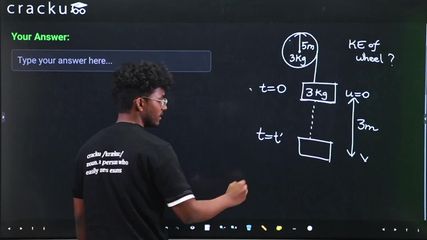
A fly wheel having mass 3 kg and radius 5 m is free to rotate about a horizontal axis. A string having negligible mass is wound around the wheel and the loose end of the string is connected to 3 kg mass. The mass is kept at rest initially and released. Kinetic energy of the wheel when the mass descends by 3 m is ___ J.$$(g=10 m/s^{2})$$
Correct Answer: 30
A flywheel (mass $$M = 3$$ kg, radius $$R = 5$$ m) has a string wound around it connected to a hanging mass ($$m = 3$$ kg). The mass descends by $$h = 3$$ m. We need the kinetic energy of the wheel.
The flywheel is a solid disc, so its moment of inertia is $$I = \dfrac{1}{2}MR^2$$. Since the string is inextensible, the linear velocity of the mass equals the tangential velocity at the rim, giving $$v = R\omega$$.
Using conservation of energy and noting that the initial state is at rest while the final state has the mass descended by $$h = 3$$ m, we write:
$$mgh = \frac{1}{2}mv^2 + \frac{1}{2}I\omega^2$$
Substituting $$\omega = \dfrac{v}{R}$$ and $$I = \dfrac{1}{2}MR^2$$ into the energy equation yields:
$$mgh = \frac{1}{2}mv^2 + \frac{1}{2}\cdot \frac{1}{2}MR^2 \cdot \frac{v^2}{R^2} = \frac{1}{2}mv^2 + \frac{1}{4}Mv^2$$
Combining terms gives
$$mgh = \frac{v^2}{2}\left(m + \frac{M}{2}\right) = \frac{v^2}{2} \cdot \frac{2m + M}{2}$$
Solving for $$v^2$$ results in
$$v^2 = \frac{4mgh}{2m + M} = \frac{4 \times 3 \times 10 \times 3}{6 + 3} = \frac{360}{9} = 40 \text{ m}^2/\text{s}^2$$
Now, the kinetic energy of the wheel is
$$KE_{\text{wheel}} = \frac{1}{2}I\omega^2 = \frac{1}{4}Mv^2 = \frac{1}{4} \times 3 \times 40 = 30 \text{ J}$$
From the above, the answer is $$\boxed{30}$$ J.
Was this solution helpful?
Click on the Email ☝️ to Watch the Video Solution
Create a FREE account and get:
_1.webp)

Educational materials for JEE preparation

Ask our AI anything

AI can make mistakes. Please verify important information.
AI can make mistakes. Please verify important information.
