
Join Our JEE Preparation Group
Prep with like-minded aspirants; Get access to free daily tests and study material.
Sign in
Please select an account to continue using cracku.in
↓ →
Join Our JEE Preparation Group
Prep with like-minded aspirants; Get access to free daily tests and study material.
A disc of radius $$R$$ and mass $$M$$ is rolling horizontally without slipping with a speed $$v$$. It then moves up an inclined smooth surface as shown in the figure. The maximum height that the disc can go up the incline is
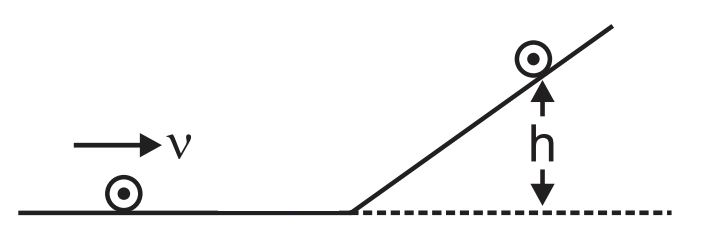
Initial Total Energy:
On the horizontal track, the disc has both translational and rotational kinetic energy:
$$E_i = \frac{1}{2}Mv^2 + \frac{1}{2}I\omega^2$$
Final Total Energy:
At the maximum height $$h$$, the translational velocity is zero, but the rotational kinetic energy remains unchanged due to the lack of friction:
$$E_f = Mgh + \frac{1}{2}I\omega^2$$
Conservation of Mechanical Energy (since there is no friction):
Equating the initial and final energy states ($$E_i = E_f$$):
$$\frac{1}{2}Mv^2 + \frac{1}{2}I\omega^2 = Mgh + \frac{1}{2}I\omega^2$$
$$\frac{1}{2}Mv^2 = Mgh$$
$$h = \frac{v^2}{2g}$$
Was this solution helpful?
Click on the Email ☝️ to Watch the Video Solution
Create a FREE account and get:
_1.webp)

Educational materials for JEE preparation

Ask our AI anything

AI can make mistakes. Please verify important information.
AI can make mistakes. Please verify important information.
