
Join Our JEE Preparation Group
Prep with like-minded aspirants; Get access to free daily tests and study material.
Sign in
Please select an account to continue using cracku.in
↓ →
Join Our JEE Preparation Group
Prep with like-minded aspirants; Get access to free daily tests and study material.
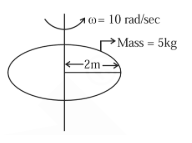
Consider a disc of mass $$5 \text{ kg}$$, radius $$2 \text{ m}$$, rotating with angular velocity of $$10 \text{ rad s}^{-1}$$ about an axis perpendicular to the plane of rotation. An identical disc is kept gently over the rotating disc along the same axis. The energy dissipated so that both the discs continue to rotate together without slipping is _________ J.
Correct Answer: 250
When the second disc is placed on the rotating one, the internal friction between their surfaces brings them to a common angular velocity. Since no external torque acts on the system about the axis of rotation, the total angular momentum is conserved.
The moment of inertia for a solid disc about its central axis is:
$$I = \frac{1}{2}MR^2 = \frac{1}{2} \times 5 \times (2)^2 = 10 \text{ kg m}^2$$
Initial angular momentum of the single disc equals the final angular momentum of the two discs rotating together:
$$I\omega_1 = (I + I)\omega_f$$
$$10 \times 10 = 20 \times \omega_f \implies \omega_f = 5 \text{ rad s}^{-1}$$
Before the second disc is added, the energy in the system is:
$$E_i = \frac{1}{2}I\omega_1^2 = \frac{1}{2} \times 10 \times (10)^2 = 500 \text{ J}$$
After both discs begin rotating together at the common velocity $$\omega_f$$:
$$E_f = \frac{1}{2}(2I)\omega_f^2 = \frac{1}{2} \times 20 \times (5)^2 = 250 \text{ J}$$
The energy lost due to friction as the discs slip against each other before reaching a common speed is the difference between the initial and final kinetic energies:
$$\Delta E = E_i - E_f = 500 - 250 = 250 \text{ J}$$
Was this solution helpful?
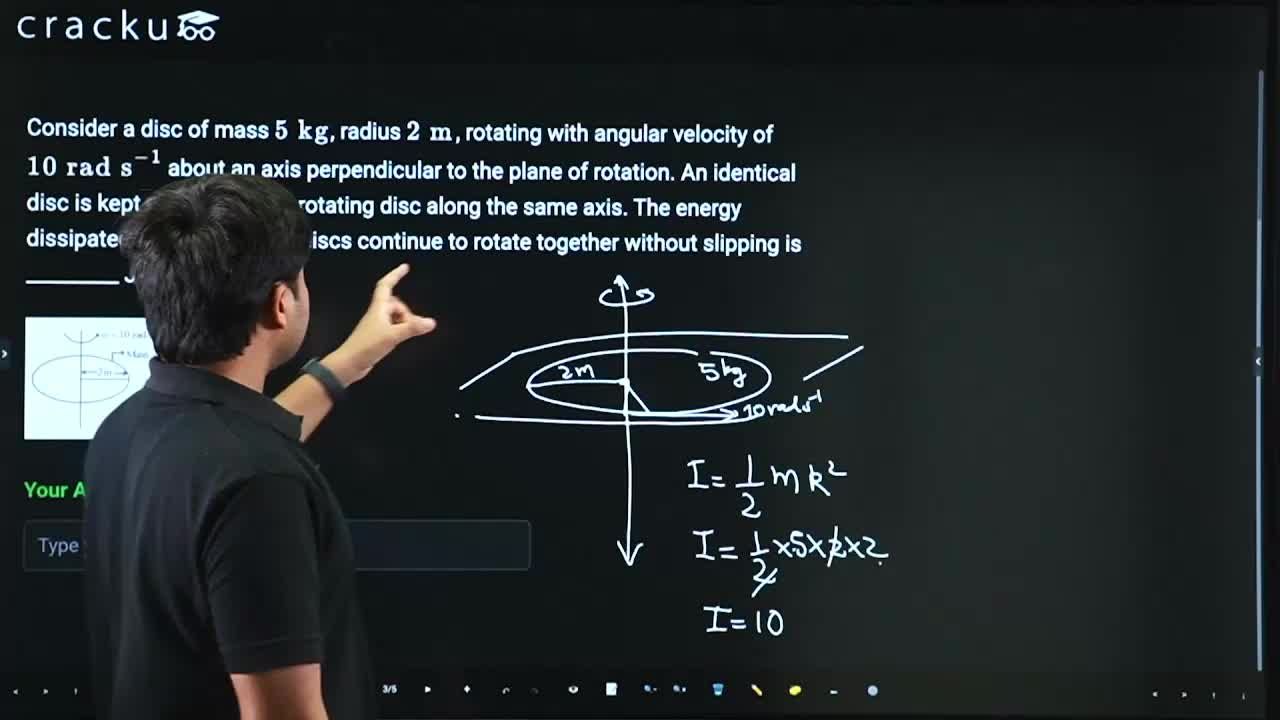
Click on the Email ☝️ to Watch the Video Solution
Create a FREE account and get:
_1.webp)

Educational materials for JEE preparation

Ask our AI anything

AI can make mistakes. Please verify important information.
AI can make mistakes. Please verify important information.
