
Join Our JEE Preparation Group
Prep with like-minded aspirants; Get access to free daily tests and study material.
Sign in
Please select an account to continue using cracku.in
↓ →
Join Our JEE Preparation Group
Prep with like-minded aspirants; Get access to free daily tests and study material.
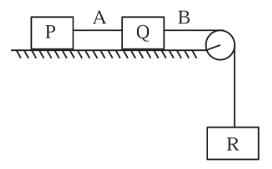
Each of the three blocks $$P$$, $$Q$$ and $$R$$ shown in the figure has a mass of $$3 \text{ kg}$$. Each of the wire $$A$$ and $$B$$ has a cross-sectional area $$0.005 \text{ cm}^2$$ and a Young's modulus $$2 \times 10^{11} \text{ N m}^{-2}$$. Neglecting friction, the longitudinal strain on wire $$B$$ is $$\_\_\_\_ \times 10^{-4}$$. (Take $$g = 10 \text{ m s}^{-2}$$)
Correct Answer: 2
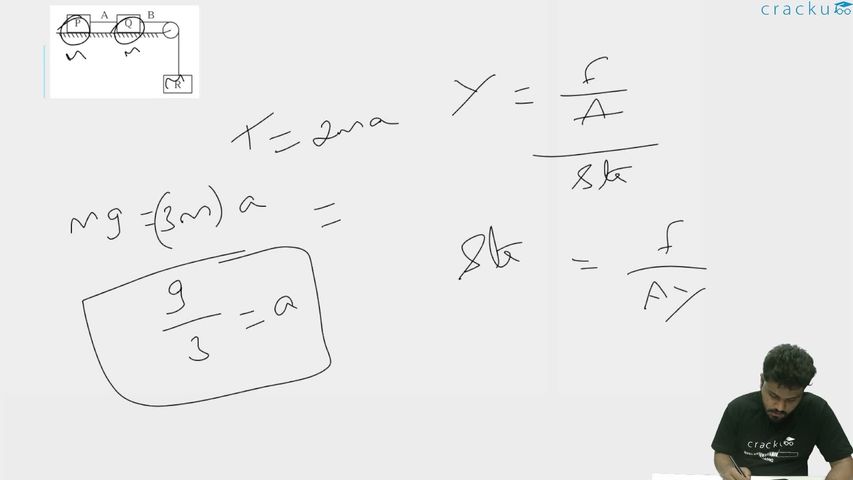
$$a = \frac{m_R g}{m_P + m_Q + m_R}$$
$$a = \frac{3 \times 10}{3 + 3 + 3} = \frac{30}{9} = \frac{10}{3} \text{ m s}^{-2}$$
Wire $$B$$ is responsible for accelerating blocks $$P$$ and $$Q$$ at the rate calculated above.
$$T_B = (m_P + m_Q) \cdot a$$
$$T_B = (3 + 3) \times \frac{10}{3} = 6 \times \frac{10}{3} = 20 \text{ N}$$
Strain is the ratio of stress to Young's modulus ($$Y$$). Stress is tension divided by the cross-sectional area ($$S$$).
$$\epsilon = \frac{\text{Stress}}{Y} = \frac{T_B}{S \cdot Y}$$
$$\epsilon = \frac{20}{(5 \times 10^{-7}) \times (2 \times 10^{11})}$$
$$\epsilon = \frac{20}{10 \times 10^4} = \frac{20}{10^5} = 2 \times 10^{-4}$$
The value is 2.
Was this solution helpful?
Click on the Email ☝️ to Watch the Video Solution
Create a FREE account and get:
_1.webp)

Educational materials for JEE preparation

Ask our AI anything

AI can make mistakes. Please verify important information.
AI can make mistakes. Please verify important information.
