
 Group
Group
 Group
Group


 Preferred Source

 Google Discover
Can an Average Student Crack JEE 2027?
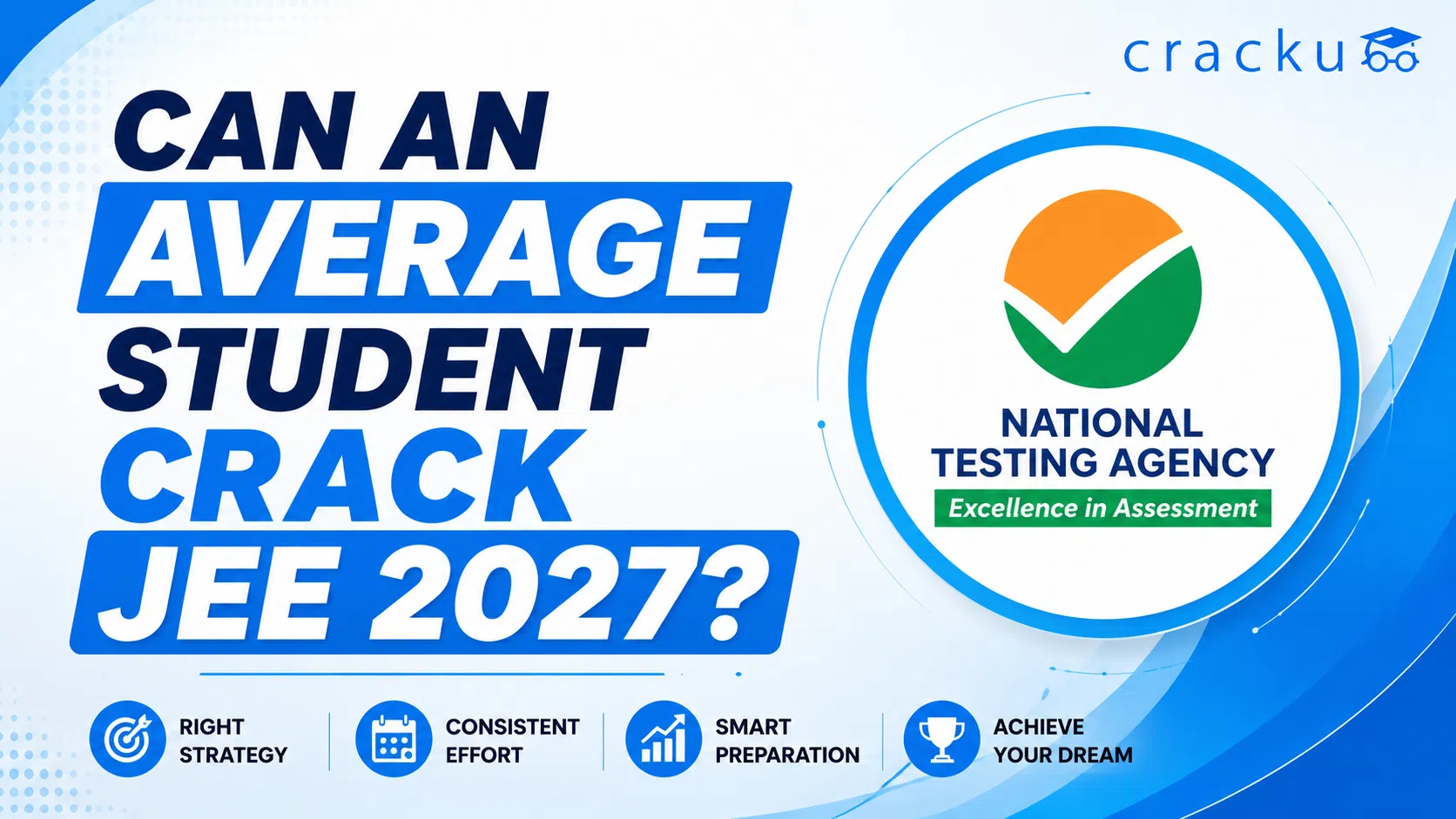
Cracking JEE 2027 is not limited to top-ranking students; even an average student can achieve it with the right approach and consistency. The Joint Entrance Examination is designed to test conceptual understanding, problem-solving ability, and time management rather than just memorisation. Many students who start with weak or average performance eventually improve significantly through disciplined study, regular practice, and continuous self-evaluation.
Success in JEE depends more on strategy than initial ability, especially when preparation starts early for JEE Main and JEE Advanced. With proper planning, focused revision, and smart use of resources like mock tests and previous year questions, an average student can steadily build strong fundamentals and improve accuracy over time. Consistency, patience, and structured preparation play a key role in achieving a good rank in JEE 2027.
Why Most Students Think They Can't Crack JEE
A large number of students feel that cracking the JEE is beyond their ability, even before they fully start preparing. This belief is usually not based on actual capability but on psychological pressure, environment, and misinformation. Understanding these reasons can help students approach preparation more realistically and confidently.
Fear Created by Competition: JEE is often described as “one of the toughest exams in the world,” and students constantly hear about lakhs of applicants competing for limited seats in IITs. This creates an early mindset that success is extremely rare, even though consistent preparation makes it achievable for many.:
Comparison with Toppers: Students frequently compare themselves with top rankers who score very high marks or solve problems quickly. This comparison leads to self-doubt, even though those toppers represent only a small fraction and usually have years of focused practice.
Lack of Proper Study Strategy: Many students don’t follow a structured plan in the beginning. Without understanding concepts properly or practising regularly, they struggle with early topics and assume the exam is “too hard” instead of adjusting their method.
Coaching Pressure and Expectations: Coaching institutes often emphasise ranks, mock test scores, and competition levels. While useful, this can sometimes create unnecessary pressure, making students feel behind even when they are progressing normally.
Early Failure in Mock Tests: When students score low in initial tests, they assume they are not capable. In reality, mock tests are meant to expose weak areas and improve performance over time.
Study Plan for an Average Student to Crack JEE 2027
Cracking JEE Main and JEE Advanced 2027 is absolutely possible for an “average” student if the preparation is consistent, concept-focused, and test-driven. You don’t need to be a topper at the start you need a system that builds you into one over time.
A clear understanding of the JEE Mains Syllabus 2027 helps in planning studies in the right direction, ensuring that no important topic is missed during preparation. Regular practice through JEE Mains Mock tests also plays a crucial role in improving speed, accuracy, and exam temperament. With disciplined preparation, continuous revision, and proper analysis of mistakes, even an average student can steadily improve performance and achieve a strong rank in JEE 2027.
Phase | Duration | Goal | Daily Study Hours | Physics Focus | Chemistry Focus | Mathematics Focus | Testing Strategy |
Phase 1: Foundation Building | June 2026 – March 2027 | Build strong basics of Class 11 & early Class 12 | 6–8 hours | Kinematics, Newton’s Laws, Work-Energy, Thermodynamics basics | NCERT reading, Physical Chemistry basics, Organic fundamentals | Algebra, Trigonometry, Coordinate Geometry | Monthly chapter tests |
Phase 2: JEE Main Level Strengthening | April – Nov 2027 | Improve speed + accuracy + JEE Main level problem solving | 8–10 hours | PYQs, Mechanics, Waves, Electrostatics | NCERT + Organic reactions + Physical numericals | Calculus, Vectors, Complex Numbers | Weekly mock tests + PYQs |
Phase 3: Advanced Level Preparation | Dec 2027 – Exam | High-level problem solving + exam readiness | 10–12 hours | Advanced multi-concept problems | Reaction mechanisms + Inorganic revision | Integration, Probability, Mixed problems | 2 mocks per week + full analysis |
Revision Phase | Last 2–3 months before exam | Final revision + mistake correction | 8–10 hours | Formula revision + weak topics | NCERT revision + reaction maps | Formula + problem revision | Full syllabus mocks + analysis |
Best Chapters to Focus on for JEE 2027 Preparation
For JEE Main and JEE Advanced, not all chapters carry equal importance. Some topics consistently contribute a large portion of the questions every year. If you are an “average student,” focusing on high-weightage and conceptually scoring chapters first will give the fastest improvement.
JEE Most Important Chapters
Priority | Chapter | Why Important |
High | Modern Physics | Very high scoring, easy formulas |
High | Current Electricity | Direct formula-based questions |
High | Electrostatics | Concept + numericals |
High | Magnetism | Repeated in exams |
High | Ray Optics | Easy + scoring |
High | Laws of Motion | Foundation of mechanics |
Medium | Work, Energy & Power | Conceptual + moderate weight |
Medium | Thermodynamics | Formula + theory mix |
Medium | SHM & Waves | Frequently asked |
Low | Rotational Motion | Tough but important for Advanced |
Physical Chemistry
Priority | Chapter |
High | Mole Concept |
High | Chemical Equilibrium |
High | Thermodynamics |
High | Electrochemistry |
High | Solutions |
Organic Chemistry
Priority | Chapter |
High | GOC (General Organic Chemistry) |
High | Hydrocarbons |
High | Alcohol, Phenol, Ether |
High | Carbonyl Compounds |
Medium | Amines |
Inorganic Chemistry
Priority | Chapter |
Very High | Chemical Bonding |
Very High | Periodic Table |
High | Coordination Compounds |
High | p-Block Elements |
Medium | d- and f-block |
How Previous Year Papers Help Average Students
JEE Mains Previous Year papers are one of the most powerful tools for JEE preparation, especially for average students. They show the real exam pattern, frequently asked concepts, and difficulty level helping students study smarter instead of just studying harder.
Understand the Exam Pattern: JEE Advanced Previous Year papers help students clearly understand how questions are asked in JEE Main and JEE Advanced. This reduces confusion about the exam format and difficulty level.
Identify Important Topics: By solving JEE Advanced Previous Year papers, students can easily see which chapters and concepts are repeated frequently. This helps them focus more on high-weightage topics instead of wasting time on less important areas.
Learn Application of Concepts: JEE Advanced Previous Year papers show how basic formulas and theories are applied in real exam questions. This helps average students connect concepts with problem-solving.
Improve Accuracy and Speed: Regular practice of JEE Chapter-wise PYQs trains students to solve questions faster and with fewer mistakes, which is very important in a time-bound exam like JEE.
Build Exam Confidence: When students solve real exam-level questions repeatedly, they become more confident and less fearful of the actual exam.
Find Weak Areas: PYQs help students identify topics where they are making mistakes, so they can revise and improve those specific areas.
Common Mistakes Average Students Make During JEE Preparation
Many students preparing for JEE lose marks and confidence, not because the exam is impossible, but because of avoidable preparation mistakes. Understanding these issues early can significantly improve performance.
Ignoring NCERT and Basic Concepts: A large number of students skip fundamentals and directly attempt advanced problems. This leads to weak conceptual clarity, especially in physics and chemistry.
Lack of Proper Study Plan: Without a structured timetable, students often study randomly. This results in incomplete syllabus coverage and poor revision.
Avoiding Previous Year Papers (PYQs): Many students focus only on JEE Study material and ignore PYQs. This reduces their understanding of exam patterns and frequently asked questions.
Excess Study Material, Less Practice: Collecting too many books and notes without solving enough questions weakens problem-solving ability.
Not Analyzing Mistakes: Students often give tests but fail to review their errors. Without analysis, the same mistakes are repeated.
Can an Average Student Crack JEE 2027?: Conclusion
Even an average student can crack JEE 2027 with the right preparation strategy. Focusing on conceptual clarity, practicing previous year questions, and following a structured phase-wise plan helps build a strong foundation. Prioritizing high-weightage chapters in Physics, Chemistry, and Mathematics ensures that students make the most of their study time and gradually improve their performance.
Consistency, discipline, and regular revision are key to success. Mock tests and chapter-wise problem-solving help students analyze mistakes, enhance speed, and gain confidence. By steadily improving accuracy and understanding exam patterns, even an average aspirant can achieve a strong rank in JEE 2027, making IIT and top engineering institutes attainable goals.
.webp)