
Join Our JEE Preparation Group
Prep with like-minded aspirants; Get access to free daily tests and study material.
Sign in
Please select an account to continue using cracku.in
↓ →
Join Our JEE Preparation Group
Prep with like-minded aspirants; Get access to free daily tests and study material.
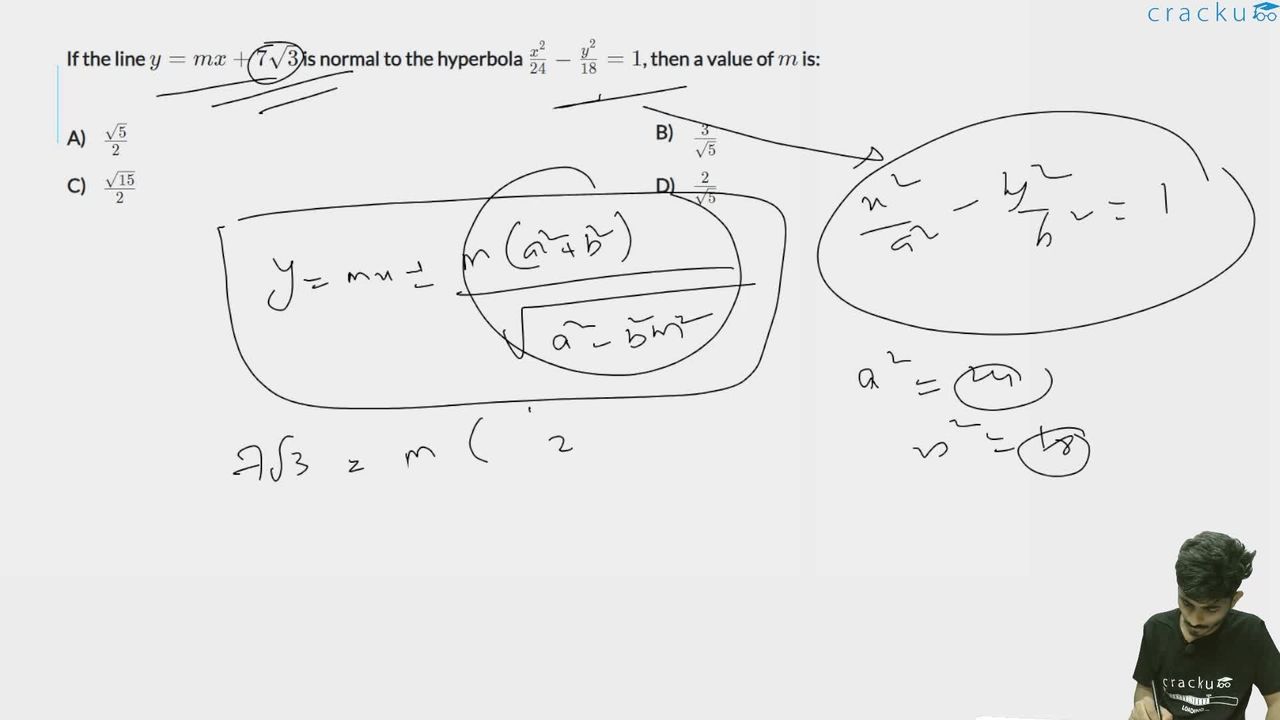
If the line $$y = mx + 7\sqrt{3}$$ is normal to the hyperbola $$\frac{x^2}{24} - \frac{y^2}{18} = 1$$, then a value of $$m$$ is:
We are given the hyperbola $$\dfrac{x^{2}}{24}-\dfrac{y^{2}}{18}=1$$ and the straight line $$y=mx+7\sqrt{3}$$. For the line to be normal to the hyperbola, two conditions must hold:
1. The slope of the line must equal the slope of the normal to the hyperbola at their point of contact.
2. The point of contact must satisfy both the equation of the hyperbola and that of the line.
First, we differentiate the hyperbola to find the slope of the tangent. Starting with $$\frac{x^{2}}{24}-\frac{y^{2}}{18}=1,$$ we differentiate implicitly with respect to $$x$$:
$$\frac{2x}{24}-\frac{2y}{18}\,\frac{dy}{dx}=0.$$
Simplifying the coefficients, we get
$$\frac{x}{12}-\frac{y}{9}\,\frac{dy}{dx}=0.$$
Solving for $$\dfrac{dy}{dx}$$ (the slope of the tangent),
$$-\frac{y}{9}\,\frac{dy}{dx}=-\frac{x}{12}\quad\Longrightarrow\quad \frac{dy}{dx}=\frac{x}{12}\cdot\frac{9}{y}=\frac{3x}{4y}.$$
The slope of the normal is the negative reciprocal of the slope of the tangent, so
$$m_{\text{normal}}=-\frac{1}{\dfrac{dy}{dx}}=-\frac{4y}{3x}.$$
If the normal passes through the point $$(x_{1},y_{1})$$ on the hyperbola, then the given line $$y=mx+7\sqrt{3}$$ must satisfy
$$m=-\frac{4y_{1}}{3x_{1}}.\qquad(1)$$
Because the point lies on the line as well, we must also have
$$y_{1}=mx_{1}+7\sqrt{3}.\qquad(2)$$
We now solve equations (1) and (2) together. From (1) we express $$y_{1}$$ in terms of $$x_{1}$$:
$$y_{1}=-\frac{3m}{4}\,x_{1}.\qquad(3)$$
Substituting (3) into (2):
$$-\frac{3m}{4}\,x_{1}-m x_{1}=7\sqrt{3}.$$
Combining the coefficients of $$x_{1}$$:
$$\left(-\frac{3}{4}-1\right)m x_{1}=7\sqrt{3}\;\;\Longrightarrow\;\; -\frac{7}{4}m x_{1}=7\sqrt{3}.$$
Dividing both sides by $$-\dfrac{7}{4}m$$, we find
$$x_{1}=\frac{7\sqrt{3}}{-\dfrac{7}{4}m}=-\frac{4\sqrt{3}}{m}.$$
Using (3) for $$y_{1}$$:
$$y_{1}=-\frac{3m}{4}\left(-\frac{4\sqrt{3}}{m}\right)=3\sqrt{3}.$$
Thus the point of contact is $$(x_{1},y_{1})=\left(-\dfrac{4\sqrt{3}}{m},\,3\sqrt{3}\right).$$ This point must satisfy the hyperbola’s equation:
$$\frac{x_{1}^{2}}{24}-\frac{y_{1}^{2}}{18}=1.$$
Computing each term:
$$x_{1}^{2}=\left(-\frac{4\sqrt{3}}{m}\right)^{2}=\frac{48}{m^{2}},\qquad y_{1}^{2}=(3\sqrt{3})^{2}=27.$$
Substituting these values,
$$\frac{\dfrac{48}{m^{2}}}{24}-\frac{27}{18}=1 \;\;\Longrightarrow\;\; \frac{2}{m^{2}}-\frac{3}{2}=1.$$
Taking all terms to one side,
$$\frac{2}{m^{2}}=1+\frac{3}{2}=\frac{5}{2}.$$
Now invert the fraction and solve for $$m^{2}$$:
$$m^{2}=\frac{2}{5}\cdot2=\frac{4}{5}.$$
Hence $$m=\pm\frac{2}{\sqrt{5}}.$$
Among the given choices only the positive value $$\dfrac{2}{\sqrt{5}}$$ appears. Hence, the correct answer is Option D.
Was this solution helpful?
Click on the Email ☝️ to Watch the Video Solution
Create a FREE account and get:
_1.webp)

Educational materials for JEE preparation

Ask our AI anything

AI can make mistakes. Please verify important information.
AI can make mistakes. Please verify important information.
