
Join Our JEE Preparation Group
Prep with like-minded aspirants; Get access to free daily tests and study material.
Sign in
Please select an account to continue using cracku.in
↓ →
Join Our JEE Preparation Group
Prep with like-minded aspirants; Get access to free daily tests and study material.
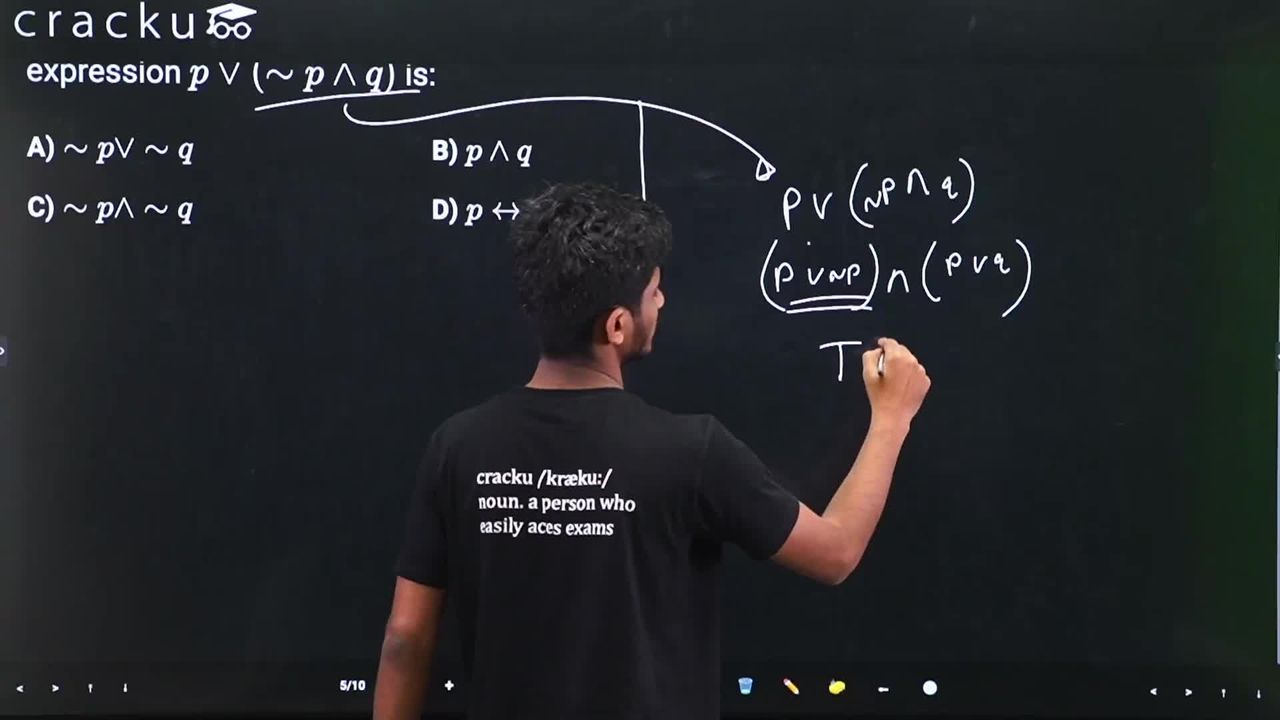
For any two statement $$p$$ and $$q$$, the negative of the expression $$p \lor (\sim p \land q)$$ is:
We begin with the given propositional expression
$$E \;=\; p \,\lor\, (\sim p \,\land\, q).$$
Our task is to find the negation $$\sim E$$ and then match it with the choices. To do this comfortably, it is convenient first to simplify $$E$$ itself.
We recall the distributive law of propositional logic, stated as
$$A \,\lor\, (B \,\land\, C)\;=\; (A \,\lor\, B)\,\land\,(A \,\lor\, C).$$
Comparing, we see $$A = p,\; B = \sim p,\; C = q.$$ Substituting we obtain
$$p \,\lor\, (\sim p \,\land\, q) \;=\; (p \,\lor\, \sim p)\,\land\,(p \,\lor\, q).$$
Now, for any statement $$p$$, the expression $$p \,\lor\, \sim p$$ is always true; it is a tautology. We may therefore replace it by the propositional constant T (True):
$$ (p \,\lor\, \sim p)\,\land\,(p \,\lor\, q) \;=\; \text{T}\,\land\,(p \,\lor\, q).$$
The conjunction of a tautology with any statement leaves that statement unchanged, because T acts like the multiplicative identity in logic. Hence
$$E \;=\; p \,\lor\, q.$$
Having reduced the original expression to $$p \lor q,$$ we now negate it. For this we invoke De Morgan’s law, which states
$$\sim(A \,\lor\, B) \;=\; \sim A \,\land\, \sim B.$$
Applying the law directly with $$A = p$$ and $$B = q,$$ we get
$$\sim E \;=\; \sim(p \,\lor\, q) \;=\; \sim p \,\land\, \sim q.$$
This final form exactly matches Option C in the list.
Hence, the correct answer is Option C.
Was this solution helpful?
Click on the Email ☝️ to Watch the Video Solution
Create a FREE account and get:
_1.webp)

Educational materials for JEE preparation

Ask our AI anything

AI can make mistakes. Please verify important information.
AI can make mistakes. Please verify important information.
