
Join Our JEE Preparation Group
Prep with like-minded aspirants; Get access to free daily tests and study material.
Sign in
Please select an account to continue using cracku.in
↓ →
Join Our JEE Preparation Group
Prep with like-minded aspirants; Get access to free daily tests and study material.
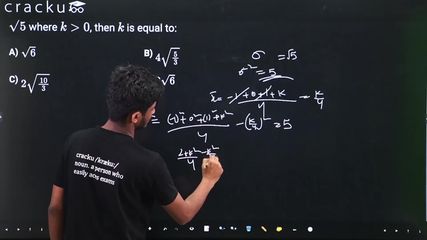
If the standard deviation of the numbers $$-1, 0, 1, k$$ is $$\sqrt{5}$$ where $$k \gt 0$$, then $$k$$ is equal to:
The formula for the standard deviation of $$n$$ observations $$x_1,x_2,\dots ,x_n$$ is
$$\sigma \;=\;\sqrt{\dfrac{1}{n}\,\sum_{i=1}^{n}(x_i-\bar x)^2},$$
where $$\bar x$$ is the arithmetic mean of the observations.
Here the four numbers are $$-1,\,0,\,1,\,k$$ with $$k \gt 0$$, so $$n = 4$$ and the given standard deviation is $$\sigma = \sqrt{5}$$.
First, we calculate the mean:
$$\bar x\;=\;\dfrac{(-1)+0+1+k}{4}\;=\;\dfrac{0+k}{4}\;=\;\dfrac{k}{4}.$$
Next, we write each squared deviation from the mean:
$$$ \begin{aligned} (-1-\bar x)^2 &= \Bigl(-1-\dfrac{k}{4}\Bigr)^2,\\[4pt] (0-\bar x)^2 &= \Bigl(0-\dfrac{k}{4}\Bigr)^2,\\[4pt] (1-\bar x)^2 &= \Bigl(1-\dfrac{k}{4}\Bigr)^2,\\[4pt] (k-\bar x)^2 &= \Bigl(k-\dfrac{k}{4}\Bigr)^2. \end{aligned} $$$
We expand each expression completely:
$$$ \begin{aligned} \Bigl(-1-\dfrac{k}{4}\Bigr)^2 &= (-1)^2+2(-1)\Bigl(-\dfrac{k}{4}\Bigr)+\Bigl(-\dfrac{k}{4}\Bigr)^2 \\ &= 1+\dfrac{k}{2}+\dfrac{k^{2}}{16},\\[6pt] \Bigl(0-\dfrac{k}{4}\Bigr)^2 &= \dfrac{k^{2}}{16},\\[6pt] \Bigl(1-\dfrac{k}{4}\Bigr)^2 &= 1-\,\dfrac{k}{2}+\dfrac{k^{2}}{16},\\[6pt] \Bigl(k-\dfrac{k}{4}\Bigr)^2 &= \Bigl(\dfrac{3k}{4}\Bigr)^2 = \dfrac{9k^{2}}{16}. \end{aligned} $$$
Now we add these four squared deviations:
$$$ \begin{aligned} S &= \left(1+\dfrac{k}{2}+\dfrac{k^{2}}{16}\right) +\left(\dfrac{k^{2}}{16}\right) +\left(1-\dfrac{k}{2}+\dfrac{k^{2}}{16}\right) +\left(\dfrac{9k^{2}}{16}\right)\\[6pt] &= \bigl(1+1\bigr)\;+\; \Bigl(\dfrac{k}{2}-\dfrac{k}{2}\Bigr)\;+\; \Bigl(\dfrac{k^{2}}{16}+\dfrac{k^{2}}{16}+\dfrac{k^{2}}{16}+\dfrac{9k^{2}}{16}\Bigr)\\[6pt] &= 2 + 0 + \dfrac{12k^{2}}{16}\\[6pt] &= 2 + \dfrac{3k^{2}}{4}. \end{aligned} $$$
By the standard deviation formula, we must have
$$\sigma = \sqrt{\dfrac{S}{n}} \;\; \Longrightarrow \;\; \sqrt{5} = \sqrt{\dfrac{2+\dfrac{3k^{2}}{4}}{4}}.$$
Squaring both sides removes the square roots:
$$$ 5 \;=\; \dfrac{2+\dfrac{3k^{2}}{4}}{4}. $$$
Multiplying by $$4$$ on both sides gives
$$$ 20 = 2+\dfrac{3k^{2}}{4}. $$$
Subtracting $$2$$ from each side, we get
$$$ 18 = \dfrac{3k^{2}}{4}. $$$
Multiplying by $$4$$ gives
$$$ 72 = 3k^{2}. $$$
Dividing by $$3$$, we obtain
$$$ k^{2} = 24. $$$
Finally, taking the positive square root (because $$k \gt 0$$) yields
$$$ k = \sqrt{24} = 2\sqrt{6}. $$$
Hence, the correct answer is Option D.
Was this solution helpful?
Click on the Email ☝️ to Watch the Video Solution
Create a FREE account and get:
_1.webp)

Educational materials for JEE preparation

Ask our AI anything

AI can make mistakes. Please verify important information.
AI can make mistakes. Please verify important information.
