
Join Our JEE Preparation Group
Prep with like-minded aspirants; Get access to free daily tests and study material.
Sign in
Please select an account to continue using cracku.in
↓ →
Join Our JEE Preparation Group
Prep with like-minded aspirants; Get access to free daily tests and study material.
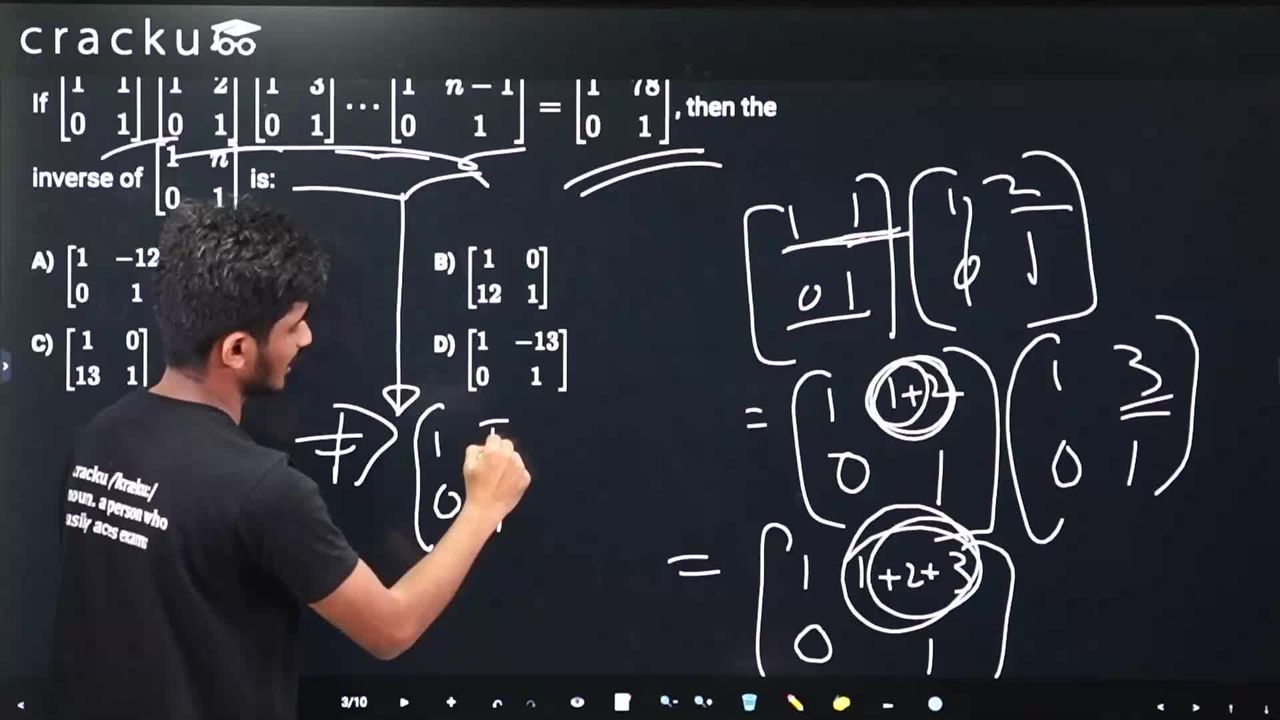
If $$\begin{bmatrix} 1 & 1 \\ 0 & 1 \end{bmatrix} \begin{bmatrix} 1 & 2 \\ 0 & 1 \end{bmatrix} \begin{bmatrix} 1 & 3 \\ 0 & 1 \end{bmatrix} \cdots \begin{bmatrix} 1 & n-1 \\ 0 & 1 \end{bmatrix} = \begin{bmatrix} 1 & 78 \\ 0 & 1 \end{bmatrix}$$, then the inverse of $$\begin{bmatrix} 1 & n \\ 0 & 1 \end{bmatrix}$$ is:
We have to evaluate the product
$$\begin{bmatrix} 1 & 1 \\ 0 & 1 \end{bmatrix} \begin{bmatrix} 1 & 2 \\ 0 & 1 \end{bmatrix} \begin{bmatrix} 1 & 3 \\ 0 & 1 \end{bmatrix} \cdots \begin{bmatrix} 1 & n-1 \\ 0 & 1 \end{bmatrix}$$
and we are told that the result equals
$$\begin{bmatrix} 1 & 78 \\ 0 & 1 \end{bmatrix}.$$
First, recall the general multiplication rule for 2 × 2 matrices. If we have two matrices of the special upper-triangular form $$A=\begin{bmatrix} 1 & a \\ 0 & 1 \end{bmatrix}, \qquad B=\begin{bmatrix} 1 & b \\ 0 & 1 \end{bmatrix},$$ then their product is obtained as follows:
$$AB=\begin{bmatrix} 1\cdot 1+ a\cdot 0 & 1\cdot b + a\cdot 1\\ 0\cdot 1+1\cdot 0 & 0\cdot b + 1\cdot 1 \end{bmatrix} =\begin{bmatrix} 1 & a+b \\ 0 & 1 \end{bmatrix}.$$
So, multiplying two such matrices simply adds their upper-right entries. Because of associativity of matrix multiplication, we can apply this fact successively. Hence, the product of all the given matrices is
$$\begin{bmatrix} 1 & 1 \\ 0 & 1 \end{bmatrix} \begin{bmatrix} 1 & 2 \\ 0 & 1 \end{bmatrix} \cdots \begin{bmatrix} 1 & n-1 \\ 0 & 1 \end{bmatrix} =\begin{bmatrix} 1 & 1+2+3+\dots+(n-1) \\ 0 & 1 \end{bmatrix}.$$
The sum in the upper-right corner is the sum of the first $$n-1$$ natural numbers. The well-known formula for this sum is
$$1+2+3+\dots+(n-1)=\frac{(n-1)n}{2}.$$
Therefore the product becomes
$$\begin{bmatrix} 1 & \dfrac{(n-1)n}{2} \\ 0 & 1 \end{bmatrix}.$$
We are told that this equals $$\begin{bmatrix} 1 & 78 \\ 0 & 1 \end{bmatrix}.$$ So the upper-right entries must be equal, giving the equation
$$\frac{(n-1)n}{2}=78.$$
Multiplying both sides by 2, we get
$$(n-1)n=156.$$
Expanding and arranging in standard quadratic form,
$$n^2-n-156=0.$$
To solve this quadratic, compute the discriminant: $$\Delta = (-1)^2 - 4(1)(-156)=1+624=625.$$ Taking the square root, $$\sqrt{625}=25$$.
Using the quadratic formula $$n=\dfrac{-b\pm\sqrt{\Delta}}{2a}$$ with $$a=1$$ and $$b=-1$$, we get
$$n=\frac{\,1\pm25\,}{2}.$$
This gives two roots: $$n=\frac{26}{2}=13 \quad\text{or}\quad n=\frac{-24}{2}=-12.$$
The problem concerns positive integers, so we accept
$$n=13.$$
Now we must find the inverse of the matrix $$\begin{bmatrix} 1 & n \\ 0 & 1 \end{bmatrix} =\begin{bmatrix} 1 & 13 \\ 0 & 1 \end{bmatrix}.$$
For any matrix of the form $$\begin{bmatrix} 1 & a \\ 0 & 1 \end{bmatrix},$$ the inverse is obtained by changing the sign of $$a$$, because
$$\begin{bmatrix} 1 & a \\ 0 & 1 \end{bmatrix} \begin{bmatrix} 1 & -a \\ 0 & 1 \end{bmatrix} =\begin{bmatrix} 1 & a-a \\ 0 & 1 \end{bmatrix} =\begin{bmatrix} 1 & 0 \\ 0 & 1 \end{bmatrix},$$
which is the identity matrix. Therefore, the inverse of $$\begin{bmatrix} 1 & 13 \\ 0 & 1 \end{bmatrix}$$ is
$$\begin{bmatrix} 1 & -13 \\ 0 & 1 \end{bmatrix}.$$
Hence, the correct answer is Option D.
Was this solution helpful?
Click on the Email ☝️ to Watch the Video Solution
Create a FREE account and get:
_1.webp)

Educational materials for JEE preparation

Ask our AI anything

AI can make mistakes. Please verify important information.
AI can make mistakes. Please verify important information.
