
Join Our JEE Preparation Group
Prep with like-minded aspirants; Get access to free daily tests and study material.
Sign in
Please select an account to continue using cracku.in
↓ →
Join Our JEE Preparation Group
Prep with like-minded aspirants; Get access to free daily tests and study material.
Let $$\alpha$$ and $$\beta$$ be the roots of the equation $$x^2 + x + 1 = 0$$. Then for $$y \neq 0$$ in R, $$\begin{vmatrix} y+1 & \alpha & \beta \\ \alpha & y+\beta & 1 \\ \beta & 1 & y+\alpha \end{vmatrix}$$ is equal to:
We have the quadratic $$x^{2}+x+1=0$$ whose roots are denoted by $$\alpha$$ and $$\beta$$. From Vieta’s formula we immediately obtain the two fundamental relations
$$\alpha+\beta=-1 \qquad\text{and}\qquad \alpha\beta=1.$$
Because $$\alpha$$ (and similarly $$\beta$$) satisfies its own quadratic, we can also write
$$\alpha^{2}+ \alpha +1 =0\;\Longrightarrow\; \alpha^{2}=-(\alpha+1),$$
and by symmetry
$$\beta^{2}=-(\beta+1).$$
Now let us denote the required determinant by $$\Delta(y)$$:
$$\Delta(y)= \begin{vmatrix} y+1 & \alpha & \beta\\ \alpha & y+\beta & 1\\ \beta & 1 & y+\alpha \end{vmatrix}. $$
Observe that the given matrix can be split into the sum of $$yI_{3}$$ (where $$I_{3}$$ is the $$3\times3$$ identity matrix) and a constant matrix $$P$$, i.e.
$$ \begin{pmatrix} y+1 & \alpha & \beta\\ \alpha & y+\beta & 1\\ \beta & 1 & y+\alpha \end{pmatrix} = y \begin{pmatrix} 1&0&0\\ 0&1&0\\ 0&0&1 \end{pmatrix} + \begin{pmatrix} 1&\alpha&\beta\\ \alpha&\beta&1\\ \beta&1&\alpha \end{pmatrix} = yI_{3}+P. $$
Hence
$$\Delta(y)=\det(yI_{3}+P).$$
For any square matrix, the determinant $$\det(\lambda I+A)$$ is the characteristic polynomial of $$-A$$ evaluated at $$\lambda$$. Therefore, letting $$\lambda=y$$, we can write the cubic polynomial
$$\Delta(y)=y^{3}+c_{2}y^{2}+c_{1}y+c_{0},$$
where the coefficients are, respectively,
$$c_{2}=\operatorname{tr}(P),\qquad c_{1}= \text{sum of all principal} \; 2\times2 \; \text{minors of } P,\qquad c_{0}= \det(P). $$
We shall now compute each coefficient explicitly.
1. The trace of $$P$$.
The entries on the main diagonal of $$P$$ are $$1,\,\beta,\,\alpha$$; therefore
$$c_{2}=\operatorname{tr}(P)=1+\beta+\alpha =1+(\alpha+\beta) =1+(-1)=0.$$
2. The sum of the principal $$2\times2$$ minors of $$P$$.
a) Minor obtained by deleting row 1 and column 1:
$$M_{11}= \begin{vmatrix} \beta & 1\\ 1 & \alpha \end{vmatrix}= \beta\alpha-1=\alpha\beta-1=1-1=0.$$
b) Minor obtained by deleting row 2 and column 2:
$$M_{22}= \begin{vmatrix} 1 & \beta\\ \beta & \alpha \end{vmatrix}=1\cdot\alpha-\beta^{2}= \alpha-\beta^{2}.$$
Using $$\beta^{2}=-(\beta+1)$$, we get
$$\alpha-\beta^{2}= \alpha+(\beta+1)= (\alpha+\beta)+1 = (-1)+1=0.$$
c) Minor obtained by deleting row 3 and column 3:
$$M_{33}= \begin{vmatrix} 1 & \alpha\\ \alpha & \beta \end{vmatrix}=1\cdot\beta-\alpha^{2}= \beta-\alpha^{2}.$$
Using $$\alpha^{2}=-(\alpha+1)$$, we get
$$\beta-\alpha^{2}= \beta+(\alpha+1)= (\alpha+\beta)+1 = (-1)+1=0.$$
Adding the three minors we obtain
$$c_{1}=M_{11}+M_{22}+M_{33}=0+0+0=0.$$
3. The determinant of $$P$$.
We first set $$y=0$$ in $$\Delta(y)$$, because $$\Delta(0)=\det(P)$$:
$$ P= \begin{pmatrix} 1 & \alpha & \beta\\ \alpha & \beta & 1\\ \beta & 1 & \alpha \end{pmatrix}. $$
Using the standard $$3\times3$$ determinant expansion,
$$$ \begin{aligned} \det(P)\;=\;& 1\bigl(\beta\alpha-1\cdot1\bigr) -\alpha\bigl(\alpha^{2}-1\cdot\beta\bigr) +\beta\bigl(\alpha\cdot1-\beta^{2}\bigr). \end{aligned} $$$
We evaluate each bracketed term in turn.
First bracket:
$$\beta\alpha-1 = \alpha\beta-1 = 1-1=0.$$
Second bracket:
$$$ \alpha^{2}-\beta = \bigl(-\alpha-1\bigr)-\beta = -(\alpha+\beta)-1 = -(-1)-1 =1-1=0. $$$
Third bracket:
$$$ \alpha-\beta^{2} = \alpha-\bigl(-\beta-1\bigr) = \alpha+\beta+1 = (-1)+1=0. $$$
Because every bracket equals zero, their linear combination is also zero, so
$$\det(P)=0 \;\Longrightarrow\; c_{0}=0.$$
Putting all coefficients together.
We have found
$$c_{2}=0,\qquad c_{1}=0,\qquad c_{0}=0,$$
so the cubic becomes simply
$$\Delta(y)=y^{3}.$$
Therefore the value of the original determinant is exactly $$y^{3}$$ for every real $$y\neq0$$ (and it is actually true even for $$y=0$$, where it vanishes).
Hence, the correct answer is Option A.
Was this solution helpful?
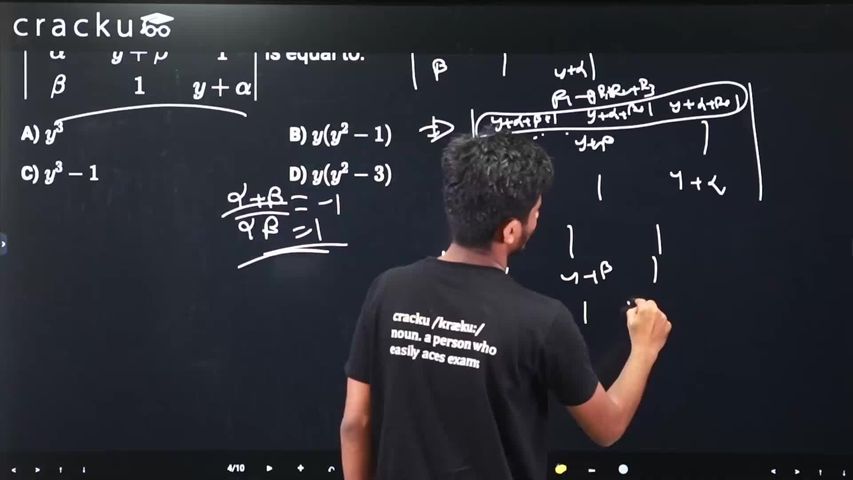
Click on the Email ☝️ to Watch the Video Solution
Create a FREE account and get:
_1.webp)

Educational materials for JEE preparation

Ask our AI anything

AI can make mistakes. Please verify important information.
AI can make mistakes. Please verify important information.
