
Join Our JEE Preparation Group
Prep with like-minded aspirants; Get access to free daily tests and study material.
Sign in
Please select an account to continue using cracku.in
↓ →
Join Our JEE Preparation Group
Prep with like-minded aspirants; Get access to free daily tests and study material.
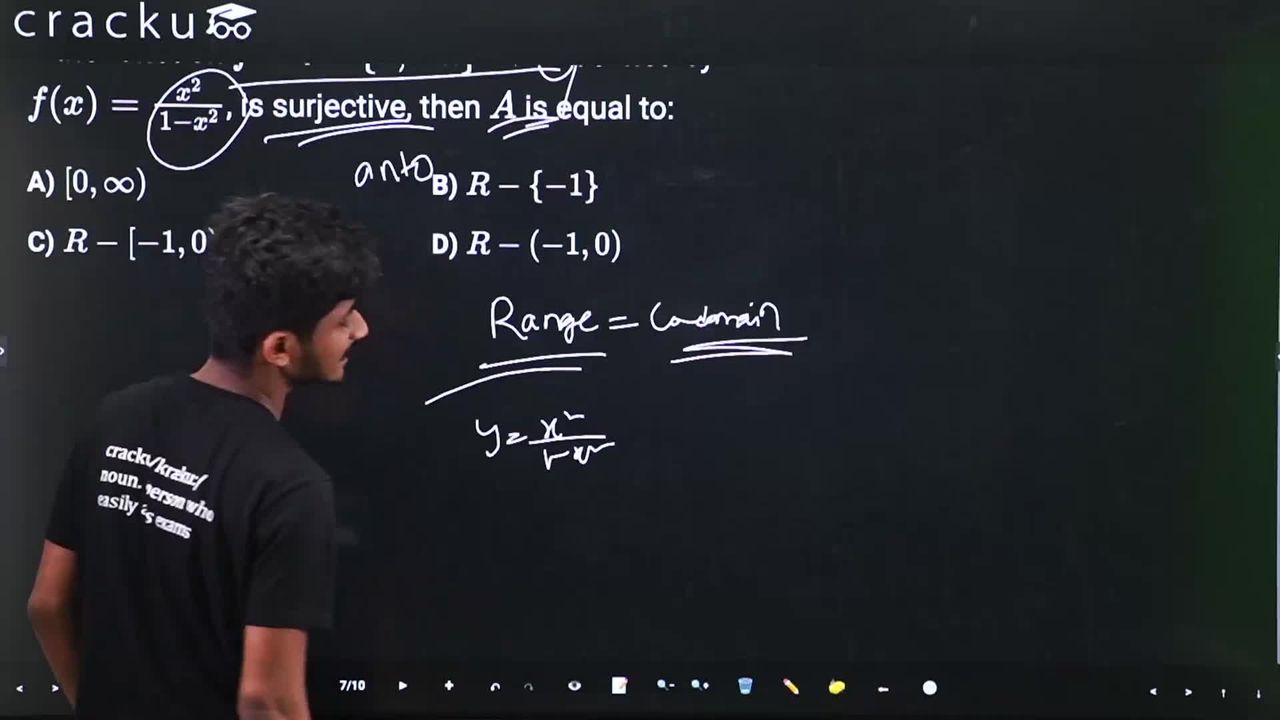
If the function $$f: R - \{1, -1\} \rightarrow A$$ defined by $$f(x) = \frac{x^2}{1 - x^2}$$, is surjective, then $$A$$ is equal to:
We are given the function $$f : \mathbb R-\{1,-1\}\to A$$ defined by
$$f(x)=\dfrac{x^{2}}{1-x^{2}}.$$
Our task is to find the set $$A$$ that makes the mapping surjective, that is, every element of $$A$$ must actually be attained as a value of $$f(x)$$ for some admissible $$x$$. So we need the precise range (image) of $$f$$.
First we notice that only the square of $$x$$ appears in the numerator, so it is convenient to set
$$t = x^{2}.$$
This substitution immediately gives two useful facts:
1. Because $$x^{2}\ge 0$$ for all real $$x$$, we have $$t\ge 0.$$
2. The domain restriction $$x\neq \pm1$$ translates to $$t\neq 1.$$ (Indeed, $$x=1$$ or $$x=-1$$ would give $$t=1$$.)
With this change of variable we can rewrite the function as
$$f(x)=\dfrac{t}{1-t},\qquad \text{where}\; t\ge 0,\; t\neq 1.$$
So the problem reduces to finding all real values $$y$$ for which the equation
$$y=\dfrac{t}{1-t}$$
has a solution $$t\ge 0,\,t\neq1.$$ We now study this rational expression carefully.
Case 1: $$0\le t<1$$.
Here the denominator $$1-t$$ is positive, and the numerator $$t$$ is non-negative. Hence
$$y=\dfrac{t}{1-t}\ge 0.$$
We analyse the end-points:
• As $$t\to0^{+}$$ we get $$y\to0.$$
• As $$t\to1^{-}$$ we have $$1-t\to0^{+}$$, so the fraction grows without bound and $$y\to +\infty.$$
Because the function $$t\mapsto\dfrac{t}{1-t}$$ is continuous on $$[0,1)$$, every non-negative real number is attained exactly once. Thus this case contributes the entire interval
$$[0,\infty).$$
Case 2: $$t>1$$.
Now the denominator $$1-t$$ is negative while the numerator $$t$$ is positive. Therefore
$$y=\dfrac{t}{1-t}<0.$$ (A positive number divided by a negative number is negative.)
Again we check limits:
• As $$t\to1^{+}$$ we have $$1-t\to0^{-}$$, so the quotient tends to $$-\infty$$.
• As $$t\to\infty$$ we use the highest-degree terms to estimate $$\dfrac{t}{1-t}=\dfrac{t}{-t\bigl(1-\tfrac1t\bigr)}\approx\dfrac{t}{-t}=-1.$$
To see exactly how it approaches $$-1$$, rearrange the expression algebraically:
$$y=\dfrac{t}{1-t}=-\,\dfrac{t}{t-1}.$$
Since $$\dfrac{t}{t-1}>1$$ for all $$t>1$$, we conclude
$$y<-1.$$
Moreover, the map $$t\mapsto -\dfrac{t}{t-1}$$ is continuous and strictly increasing on $$(1,\infty)$$, so it takes every value from $$-\infty$$ up to (but not including) $$-1$$. Hence this case contributes the interval
$$(-\infty,-1).$$
Combining both cases, we obtain
$$\text{Range}(f)=(-\infty,-1)\,\cup\,[0,\infty).$$
Equivalently, this is the set of all real numbers except those belonging to the open interval $$(-1,0)$$, and we must exclude the single point $$-1$$ itself because it never occurs. Therefore the range can be written succinctly as
$$\mathbb R-\bigl[-1,0\bigr).$$
Among the given options, this set appears exactly as Option C.
Hence, the correct answer is Option C.
Was this solution helpful?
Click on the Email ☝️ to Watch the Video Solution
Create a FREE account and get:
_1.webp)

Educational materials for JEE preparation

Ask our AI anything

AI can make mistakes. Please verify important information.
AI can make mistakes. Please verify important information.
