
Join Our JEE Preparation Group
Prep with like-minded aspirants; Get access to free daily tests and study material.
Sign in
Please select an account to continue using cracku.in
↓ →
Join Our JEE Preparation Group
Prep with like-minded aspirants; Get access to free daily tests and study material.
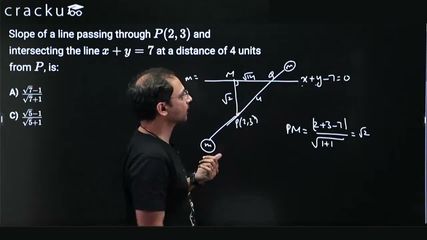
Slope of a line passing through $$P(2, 3)$$ and intersecting the line $$x + y = 7$$ at a distance of 4 units from $$P$$, is:
Let the required line pass through the fixed point $$P(2,3)$$ and have slope $$m$$. The two-point form of the equation of a line tells us that a line through $$P(x_1,y_1)$$ with slope $$m$$ is written as $$y-y_1=m(x-x_1)$$. Using $$x_1=2,\;y_1=3$$ we therefore write
$$y-3=m(x-2).$$
This same line meets the given line $$x+y=7$$ at some point $$Q(x,y)$$. At the point of intersection both equations are satisfied, so we equate the expressions for $$y$$.
From the first line we have $$y=3+m(x-2)$$, while from the second we have $$y=7-x$$. Setting them equal,
$$3+m(x-2)=7-x.$$
Expanding and rearranging,
$$m(x-2)+3=7-x$$
$$m(x-2)=4-x$$
$$mx-2m+x=4$$
$$(m+1)\,x=4+2m.$$
So, provided $$m\neq-1$$, the abscissa of $$Q$$ is
$$x=\frac{4+2m}{m+1}.$$
The ordinate is obtained from $$y=7-x$$:
$$y=7-\frac{4+2m}{m+1}.$$
We now compute the vector $$\overrightarrow{PQ}=(x-2,\;y-3)$$, because the distance $$PQ$$ must be $$4$$ units. Substituting the expressions just found:
$$x-2=\frac{4+2m}{m+1}-2 =\frac{4+2m-2(m+1)}{m+1} =\frac{4+2m-2m-2}{m+1} =\frac{2}{m+1},$$
and
$$y-3=7-\frac{4+2m}{m+1}-3 =\frac{7(m+1)-(4+2m)-3(m+1)}{m+1} =\frac{7m+7-4-2m-3m-3}{m+1} =\frac{2m}{m+1}.$$
Thus
$$\overrightarrow{PQ}=\left(\frac{2}{m+1},\;\frac{2m}{m+1}\right).$$
The distance formula states $$PQ=\sqrt{(x-2)^2+(y-3)^2}$$, so
$$PQ^2=\left(\frac{2}{m+1}\right)^2+\left(\frac{2m}{m+1}\right)^2 =\frac{4(1+m^2)}{(m+1)^2}.$$
This distance must equal $$4$$, so its square must equal $$16$$:
$$\frac{4(1+m^2)}{(m+1)^2}=16.$$
Dividing both sides by $$4$$,
$$\frac{1+m^2}{(m+1)^2}=4.$$
Cross-multiplying,
$$1+m^2=4(m+1)^2 =4(m^2+2m+1) =4m^2+8m+4.$$
Bringing all terms to one side,
$$0=4m^2+8m+4-(1+m^2) =3m^2+8m+3.$$
Hence the required slope(s) satisfy the quadratic equation
$$3m^2+8m+3=0.$$
Using the quadratic formula $$m=\dfrac{-b\pm\sqrt{b^2-4ac}}{2a}$$ with $$a=3,\;b=8,\;c=3$$, we obtain
$$m=\frac{-8\pm\sqrt{8^2-4\cdot3\cdot3}}{2\cdot3} =\frac{-8\pm\sqrt{64-36}}{6} =\frac{-8\pm\sqrt{28}}{6} =\frac{-8\pm2\sqrt7}{6} =\frac{-4\pm\sqrt7}{3}.$$
This gives two numerical values. To match them with the options we simplify one of them:
$$m_1=\frac{-4+\sqrt7}{3}=-\frac{4-\sqrt7}{3},$$
$$m_2=\frac{-4-\sqrt7}{3}.$$
Now compare $$m_1$$ with the alternatives. Multiplying the numerator and denominator of Option B by $$(1-\sqrt7)$$ we see
$$\frac{1-\sqrt7}{1+\sqrt7} =-\frac{\sqrt7-1}{1+\sqrt7} =-\frac{(\sqrt7-1)(1-\sqrt7)}{(1+\sqrt7)(1-\sqrt7)} =-\frac{(\sqrt7-1)(1-\sqrt7)}{1-7} =-\frac{(\sqrt7-1)(1-\sqrt7)}{-6} =\frac{(\sqrt7-1)(\sqrt7-1)}{6} =\frac{7-2\sqrt7+1}{6} =\frac{8-2\sqrt7}{6} =\frac{-4+\sqrt7}{3}=m_1.$$
Thus $$m_1$$ is exactly the value given in Option 2, while $$m_2$$ does not correspond to any listed option. Therefore the slope consistent with the problem statement is
$$m=\frac{1-\sqrt7}{1+\sqrt7}.$$
Hence, the correct answer is Option 2.
Was this solution helpful?
Click on the Email ☝️ to Watch the Video Solution
Create a FREE account and get:
_1.webp)

Educational materials for JEE preparation

Ask our AI anything

AI can make mistakes. Please verify important information.
AI can make mistakes. Please verify important information.
