
Join Our JEE Preparation Group
Prep with like-minded aspirants; Get access to free daily tests and study material.
Sign in
Please select an account to continue using cracku.in
↓ →
Join Our JEE Preparation Group
Prep with like-minded aspirants; Get access to free daily tests and study material.
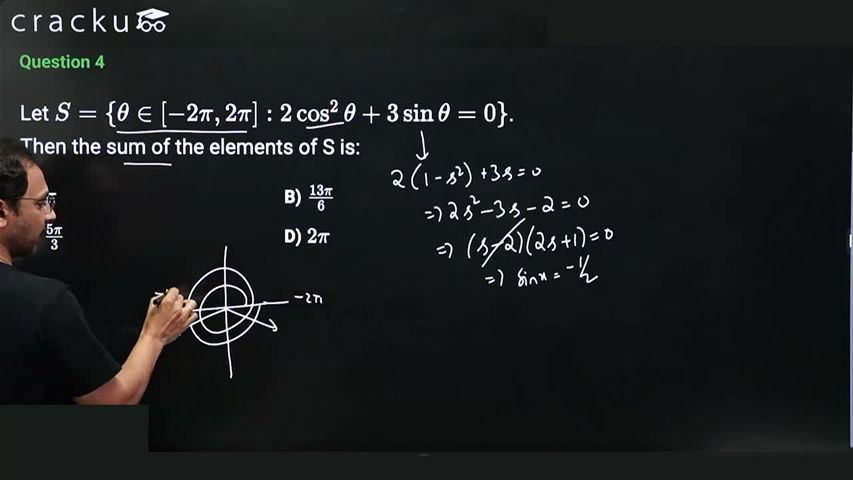
Let $$S = \{\theta \in [-2\pi, 2\pi] : 2\cos^2\theta + 3\sin\theta = 0\}$$. Then the sum of the elements of S is:
We are asked to find every $$\theta$$ lying in the closed interval $$[-2\pi,\,2\pi]$$ that satisfies the trigonometric equation
$$2\cos^2\theta + 3\sin\theta = 0.$$
First, we convert the entire equation into a single trigonometric function. We recall the Pythagorean identity
$$\sin^2\theta + \cos^2\theta = 1 \quad\Longrightarrow\quad \cos^2\theta = 1 - \sin^2\theta.$$
Substituting $$\cos^2\theta = 1 - \sin^2\theta$$ in the given equation, we obtain
$$2(1 - \sin^2\theta) + 3\sin\theta = 0.$$
Simplifying term by term, we have
$$2 - 2\sin^2\theta + 3\sin\theta = 0.$$
Let us set $$x = \sin\theta$$ for convenience. Rewriting the equation in terms of $$x$$ gives
$$2 - 2x^2 + 3x = 0.$$
Next, we collect like terms and arrange them in descending powers of $$x$$:
$${-2x^2} + 3x + 2 = 0.$$
Multiplying every term by $$-1$$ (which does not change the solution set) yields the more familiar quadratic form
$$2x^2 - 3x - 2 = 0.$$
We solve this quadratic equation with the quadratic formula. For $$ax^2 + bx + c = 0,$$ the roots are
$$x = \frac{-b \pm \sqrt{\,b^2 - 4ac\,}}{2a}.$$
Here $$a = 2,\; b = -3,\; c = -2.$$ Substituting these values, we find
$$x = \frac{-(-3) \pm \sqrt{\,(-3)^2 - 4(2)(-2)\,}}{2(2)} = \frac{3 \pm \sqrt{\,9 + 16\,}}{4} = \frac{3 \pm \sqrt{25}}{4} = \frac{3 \pm 5}{4}.$$
This gives two possible roots:
$$x_1 = \frac{3 + 5}{4} = \frac{8}{4} = 2, \qquad x_2 = \frac{3 - 5}{4} = \frac{-2}{4} = -\frac12.$$
Since $$x = \sin\theta$$ must lie in the interval $$[-1,\,1],$$ the value $$x = 2$$ is impossible and must be discarded. Thus the only admissible value is
$$\sin\theta = -\frac12.$$
We now solve $$\sin\theta = -\dfrac12$$ for all $$\theta$$ in the range $$[-2\pi,\,2\pi].$$ On the unit circle, the sine function equals $$-\dfrac12$$ at the following standard positions:
$$\theta = -\frac\pi6 + 2k\pi, \qquad\theta = -\frac{5\pi}6 + 2k\pi,$$
where $$k \in \mathbb Z.$$ These are the fourth- and third-quadrant angles corresponding to sine $$-\dfrac12.$$ We list integral values of $$k$$ that keep $$\theta$$ within $$[-2\pi,\,2\pi]$$ and record each distinct angle.
Taking $$k = 0$$
$$\theta_1 = -\frac\pi6, \qquad \theta_2 = -\frac{5\pi}6.$$
Taking $$k = 1$$
$$\theta_3 = -\frac\pi6 + 2\pi = -\frac\pi6 + \frac{12\pi}6 = \frac{11\pi}6,$$
$$\theta_4 = -\frac{5\pi}6 + 2\pi = -\frac{5\pi}6 + \frac{12\pi}6 = \frac{7\pi}6.$$
Taking $$k = -1$$ would produce
$$\theta = -\frac\pi6 - 2\pi = -\frac{13\pi}6 \lt -2\pi,$$
$$\theta = -\frac{5\pi}6 - 2\pi = -\frac{17\pi}6 \lt -2\pi,$$
both of which lie outside the prescribed interval, so they are excluded. Similarly, $$k = 2$$ gives angles greater than $$2\pi.$$ Therefore the complete solution set is
$$S = \Bigl\{-\frac{5\pi}6,\; -\frac\pi6,\; \frac{7\pi}6,\; \frac{11\pi}6\Bigr\}.$$
We now compute the sum of these four angles:
$$\Bigl(-\frac{5\pi}6\Bigr) + \Bigl(-\frac\pi6\Bigr) + \frac{7\pi}6 + \frac{11\pi}6 = \left(-\frac{6\pi}6\right) + \frac{18\pi}6 = -\pi + 3\pi = 2\pi.$$
Thus the sum of all elements of $$S$$ equals $$2\pi.$$ Among the given options, this value corresponds to Option D.
Hence, the correct answer is Option D.
Was this solution helpful?
Click on the Email ☝️ to Watch the Video Solution
Create a FREE account and get:
_1.webp)

Educational materials for JEE preparation

Ask our AI anything

AI can make mistakes. Please verify important information.
AI can make mistakes. Please verify important information.
