
Join Our JEE Preparation Group
Prep with like-minded aspirants; Get access to free daily tests and study material.
Sign in
Please select an account to continue using cracku.in
↓ →
Join Our JEE Preparation Group
Prep with like-minded aspirants; Get access to free daily tests and study material.
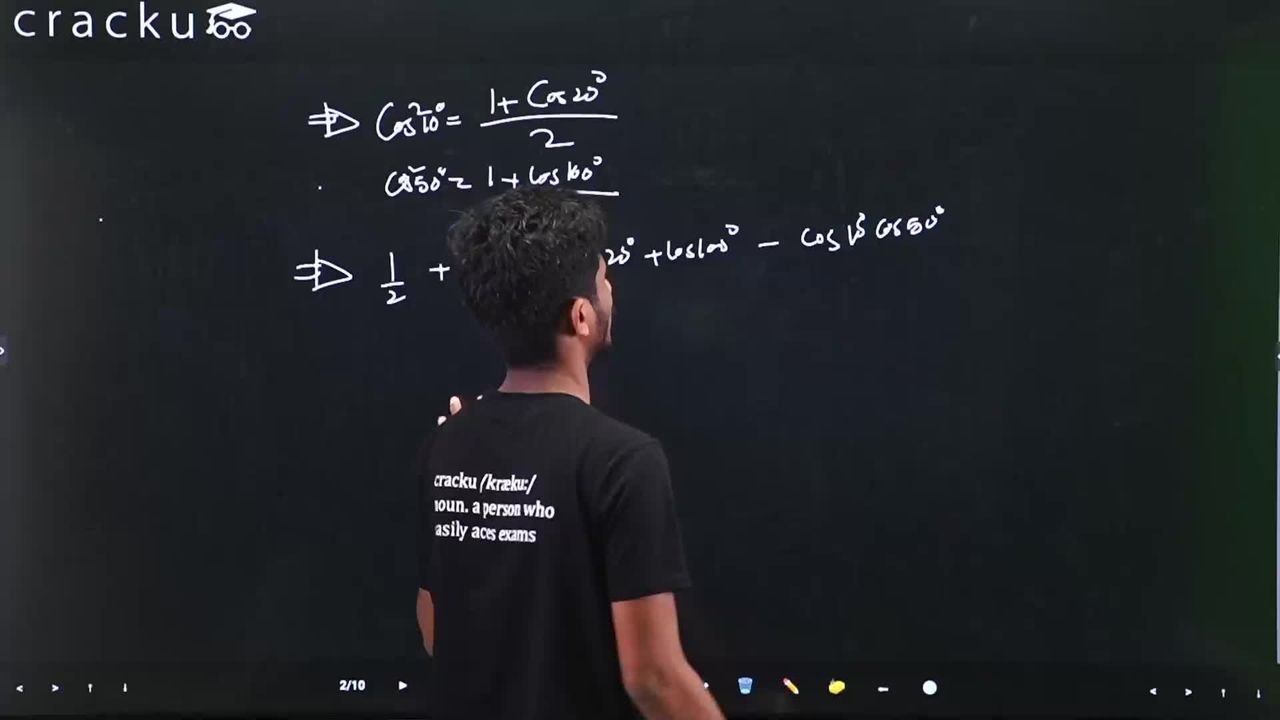
We have to find the value of the expression $$\cos^2 10^\circ-\cos 10^\circ\cos 50^\circ+\cos^2 50^\circ.$$
First, we convert each squared cosine term by using the identity
$$\cos^2\theta=\frac{1+\cos 2\theta}{2}.$$
Applying this to the two squared terms gives
$$\cos^2 10^\circ=\frac{1+\cos 20^\circ}{2},\qquad \cos^2 50^\circ=\frac{1+\cos 100^\circ}{2}.$$
Substituting these into the original expression, we obtain
$$\cos^2 10^\circ-\cos 10^\circ\cos 50^\circ+\cos^2 50^\circ =\frac{1+\cos 20^\circ}{2}-\cos 10^\circ\cos 50^\circ +\frac{1+\cos 100^\circ}{2}.$$
Now we combine the two half-fractions:
$$\frac{1+\cos 20^\circ}{2}+\frac{1+\cos 100^\circ}{2} =\frac{2+\cos 20^\circ+\cos 100^\circ}{2} =1+\frac{\cos 20^\circ+\cos 100^\circ}{2}.$$
So the whole expression turns into
$$1+\frac{\cos 20^\circ+\cos 100^\circ}{2}-\cos 10^\circ\cos 50^\circ.$$
Next we simplify $$\cos 100^\circ$$. Since $$100^\circ=180^\circ-80^\circ,$$ we use $$\cos(180^\circ-\alpha)=-\cos\alpha$$ to get
$$\cos 100^\circ=-\cos 80^\circ.$$
Hence $$\cos 20^\circ+\cos 100^\circ=\cos 20^\circ-\cos 80^\circ,$$ and the expression becomes
$$1+\frac{\cos 20^\circ-\cos 80^\circ}{2}-\cos 10^\circ\cos 50^\circ.$$
To handle the product $$\cos 10^\circ\cos 50^\circ,$$ we employ the product-to-sum identity
$$\cos A\cos B=\frac{\cos(A+B)+\cos(A-B)}{2}.$$
Taking $$A=10^\circ, B=50^\circ$$ gives
$$\cos 10^\circ\cos 50^\circ =\frac{\cos(10^\circ+50^\circ)+\cos(10^\circ-50^\circ)}{2} =\frac{\cos 60^\circ+\cos(-40^\circ)}{2}.$$
Because $$\cos(-\alpha)=\cos\alpha,$$ we have $$\cos(-40^\circ)=\cos 40^\circ,$$ and since $$\cos 60^\circ=\frac12,$$ we get
$$\cos 10^\circ\cos 50^\circ =\frac{\frac12+\cos 40^\circ}{2} =\frac14+\frac{\cos 40^\circ}{2}.$$
Substituting this back, we arrive at
$$1+\frac{\cos 20^\circ-\cos 80^\circ}{2}-\left(\frac14+\frac{\cos 40^\circ}{2}\right) =1-\frac14+\frac{\cos 20^\circ-\cos 80^\circ-\cos 40^\circ}{2}.$$
The constant terms combine to give $$\frac34,$$ so we now focus on the bracket:
$$\cos 20^\circ-\cos 80^\circ-\cos 40^\circ.$$
We first simplify $$\cos 20^\circ-\cos 40^\circ$$ using the difference identity
$$\cos A-\cos B=-2\sin\frac{A+B}{2}\sin\frac{A-B}{2}.$$
Here $$A=20^\circ, B=40^\circ,$$ so
$$\cos 20^\circ-\cos 40^\circ =-2\sin\frac{20^\circ+40^\circ}{2}\sin\frac{20^\circ-40^\circ}{2} =-2\sin 30^\circ\sin(-10^\circ).$$
Because $$\sin 30^\circ=\frac12$$ and $$\sin(-10^\circ)=-\sin 10^\circ,$$ we get
$$\cos 20^\circ-\cos 40^\circ =-2\left(\frac12\right)(-\sin 10^\circ) =\sin 10^\circ.$$
So the whole bracket becomes
$$\sin 10^\circ-\cos 80^\circ.$$
But $$\cos 80^\circ=\sin 10^\circ$$ (since $$\cos\theta=\sin(90^\circ-\theta)$$), therefore
$$\sin 10^\circ-\cos 80^\circ=\sin 10^\circ-\sin 10^\circ=0.$$
Thus the entire numerator of the fraction is zero, and the fractional part vanishes. We are left with
$$\frac34+0=\frac34.$$
Hence, the correct answer is Option A.
Was this solution helpful?
Click on the Email ☝️ to Watch the Video Solution
Create a FREE account and get:
_1.webp)

Educational materials for JEE preparation

Ask our AI anything

AI can make mistakes. Please verify important information.
AI can make mistakes. Please verify important information.
