
Join Our JEE Preparation Group
Prep with like-minded aspirants; Get access to free daily tests and study material.
Sign in
Please select an account to continue using cracku.in
↓ →
Join Our JEE Preparation Group
Prep with like-minded aspirants; Get access to free daily tests and study material.
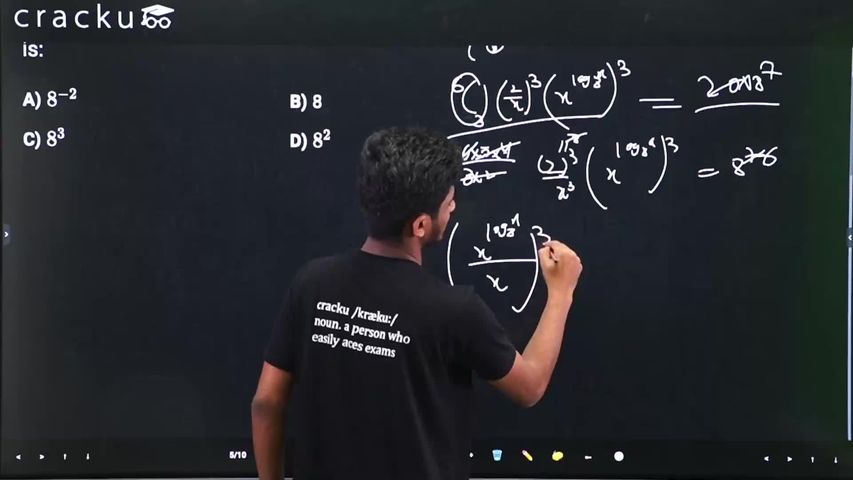
If the fourth term in the Binomial expansion of $$\left(\frac{2}{x} + x^{\log_8 x}\right)^6$$, $$(x > 0)$$ is $$20 \times 8^7$$, then a value of $$x$$ is:
The expansion of $$(a+b)^n$$ has its general, that is, $$(r+1)^{\text{th}}$$, term given by the binomial-theorem formula
$$T_{r+1}=\,^nC_r\,a^{\,n-r}\,b^{\,r}\,.$$
In the present problem we have
$$n=6,\qquad a=\dfrac{2}{x},\qquad b=x^{\log_8 x}.$$
The fourth term corresponds to $$r+1=4\; \Longrightarrow\; r=3$$, so according to the formula we write
$$T_4={}^{6}C_{3}\left(\dfrac{2}{x}\right)^{6-3}\left(x^{\log_8 x}\right)^{3}.$$
Calculating the binomial coefficient first,
$$^{6}C_{3}=\dfrac{6!}{3!\,3!}=20.$$
Now evaluate each power separately.
$$\left(\dfrac{2}{x}\right)^{6-3}=\left(\dfrac{2}{x}\right)^{3}=\dfrac{2^{3}}{x^{3}}=\dfrac{8}{x^{3}}.$$
$$\left(x^{\log_8 x}\right)^{3}=x^{3\log_8 x}\; \bigl(\text{because }(x^{m})^{k}=x^{mk}\bigr).$$
Multiplying all the factors we obtain
$$T_4=20\;\times\;\dfrac{8}{x^{3}}\;\times\;x^{3\log_8 x}=160\,x^{\,3\log_8 x-3}.$$
The statement of the question tells us that this fourth term is equal to $$20\times 8^{7}$$, so we set
$$160\,x^{\,3\log_8 x-3}=20\,8^{7}.$$
Dividing both sides by $$20$$ gives
$$8\,x^{\,3\log_8 x-3}=8^{7}.$$
Now divide both sides by $$8$$:
$$x^{\,3\log_8 x-3}=8^{6}.$$
The base $$8$$ is convenient, so let us represent $$x$$ itself as a power of $$8$$. Put
$$x=8^{k}\qquad(k\in\mathbb{R}).$$
Then
$$\log_8 x=\log_8\!\bigl(8^{k}\bigr)=k.$$
Substituting these into the exponent of $$x$$ in the previous equation, we get
$$x^{\,3\log_8 x-3}=x^{\,3k-3}=\bigl(8^{k}\bigr)^{3k-3}=8^{\,k\,(3k-3)}.$$
Therefore the equality becomes
$$8^{\,k\,(3k-3)}=8^{6}.$$
Since the bases are identical and positive (both equal to $$8$$), the exponents must be equal:
$$k\,(3k-3)=6.$$
Simplify this quadratic equation:
$$3k^{2}-3k-6=0 \;\Longrightarrow\; k^{2}-k-2=0\quad(\text{dividing by }3).$$
Factorising,
$$(k-2)(k+1)=0\;\Longrightarrow\;k=2\quad\text{or}\quad k=-1.$$
Each possible value of $$k$$ gives a corresponding value of $$x$$ via $$x=8^{k}$$:
$$k=2\;\Rightarrow\;x=8^{2}=64,$$
$$k=-1\;\Rightarrow\;x=8^{-1}=\dfrac{1}{8}.$$
Among the answer choices provided, only $$x=8^{2}$$ appears. Hence, the correct answer is Option D.
Was this solution helpful?
Click on the Email ☝️ to Watch the Video Solution
Create a FREE account and get:
_1.webp)

Educational materials for JEE preparation

Ask our AI anything

AI can make mistakes. Please verify important information.
AI can make mistakes. Please verify important information.
