
Join Our JEE Preparation Group
Prep with like-minded aspirants; Get access to free daily tests and study material.
Sign in
Please select an account to continue using cracku.in
↓ →
Join Our JEE Preparation Group
Prep with like-minded aspirants; Get access to free daily tests and study material.
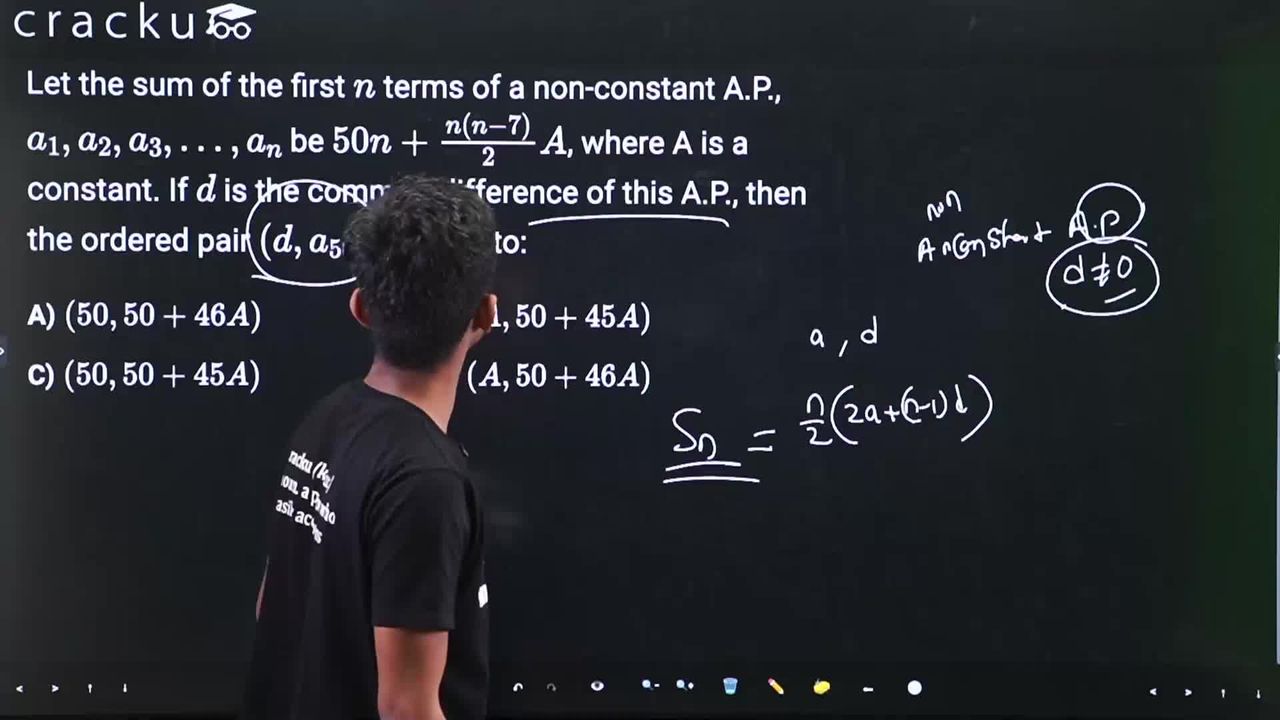
Let the sum of the first $$n$$ terms of a non-constant A.P., $$a_1, a_2, a_3, \ldots, a_n$$ be $$50n + \frac{n(n-7)}{2}A$$, where A is a constant. If $$d$$ is the common difference of this A.P., then the ordered pair $$(d, a_{50})$$ is equal to:
We are told that the sum of the first $$n$$ terms of a non-constant arithmetic progression (A.P.) is
$$S_n = 50n + \frac{n(n-7)}{2}\,A,$$
where $$A$$ is a constant. For any A.P. whose first term is $$a_1$$ and common difference is $$d$$, the standard formula for the sum of the first $$n$$ terms is
$$S_n = \frac{n}{2}\left[2a_1 + (n-1)d\right].$$
Equating the two expressions for $$S_n$$, we have
$$\frac{n}{2}\left[2a_1 + (n-1)d\right] = 50n + \frac{n(n-7)}{2}\,A.$$
Because the factor $$\dfrac{n}{2}$$ appears on both sides, we divide the entire equation by $$\dfrac{n}{2}$$ (noting that the A.P. is non-constant so $$n\neq0$$):
$$2a_1 + (n-1)d = 100 + A(n-7).$$
Expanding each side yields
$$2a_1 + nd - d = 100 + An - 7A.$$
Now we collect the terms involving $$n$$ and the constant terms separately. The left side contains $$nd$$ as the coefficient of $$n$$ and $$2a_1 - d$$ as the constant part, while the right side contains $$An$$ as the coefficient of $$n$$ and $$100 - 7A$$ as the constant part:
$$\underbrace{nd}_{\text{coefficient of }n} \;+\; \underbrace{(2a_1 - d)}_{\text{constant}} \;=\; \underbrace{An}_{\text{coefficient of }n} \;+\; \underbrace{(100 - 7A)}_{\text{constant}}.$$
Since this identity must hold for every value of $$n$$, the coefficients of corresponding powers of $$n$$ must match. Therefore, we obtain two separate equations:
Coefficient of $$n$$: $$d = A,$$
Constant term: $$2a_1 - d = 100 - 7A.$$
Substituting $$d = A$$ into the second equation, we find
$$2a_1 - A = 100 - 7A,$$
so
$$2a_1 = 100 - 7A + A = 100 - 6A,$$
and hence
$$a_1 = 50 - 3A.$$
To obtain the fiftieth term $$a_{50}$$, we recall the general term of an A.P.,
$$a_n = a_1 + (n-1)d.$$
With $$n = 50$$ and using $$d = A$$, we have
$$a_{50} = a_1 + 49d = (50 - 3A) + 49A = 50 + 46A.$$
Thus the ordered pair $$(d,\;a_{50})$$ is
$$(A,\,50 + 46A).$$
Hence, the correct answer is Option D.
Was this solution helpful?
Click on the Email ☝️ to Watch the Video Solution
Create a FREE account and get:
_1.webp)

Educational materials for JEE preparation

Ask our AI anything

AI can make mistakes. Please verify important information.
AI can make mistakes. Please verify important information.
