
Join Our JEE Preparation Group
Prep with like-minded aspirants; Get access to free daily tests and study material.
Sign in
Please select an account to continue using cracku.in
↓ →
Join Our JEE Preparation Group
Prep with like-minded aspirants; Get access to free daily tests and study material.
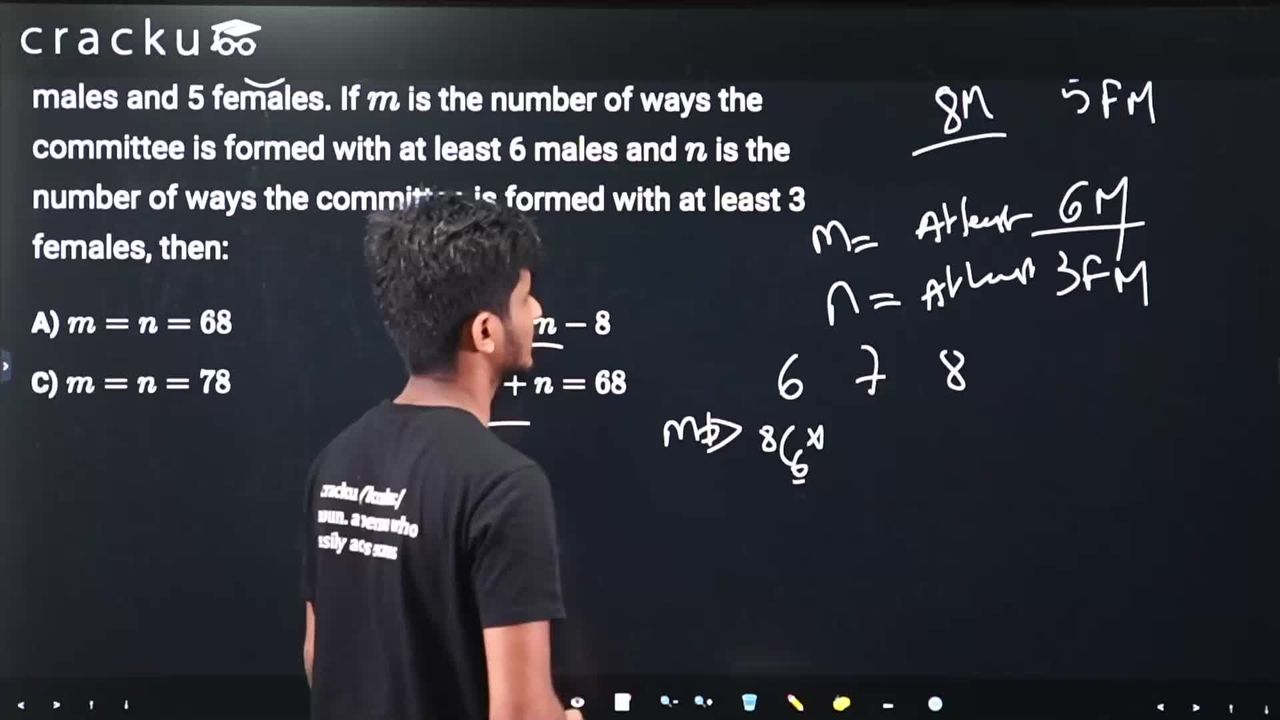
A committee of 11 members is to be formed from 8 males and 5 females. If $$m$$ is the number of ways the committee is formed with at least 6 males and $$n$$ is the number of ways the committee is formed with at least 3 females, then:
We have a total of 8 males and 5 females, so altogether $$8+5=13$$ people. A committee must have 11 members.
Remember the basic combination formula: to choose $$r$$ objects from $$n$$ distinct objects, the number of ways is given by $$^nC_r=\dfrac{n!}{r!\,(n-r)!}$$.
First we find $$m$$, the number of committees that contain at least 6 males. “At least 6” means 6 or 7 or 8 males can be in the committee. Because the committee has 11 members in total, once we decide the number of males, the number of females is automatically fixed.
For 6 males we need $$11-6=5$$ females. The number of ways is $$ ^8C_6 \times ^5C_5 =28\times1 =28. $$
For 7 males we need $$11-7=4$$ females. The number of ways is $$ ^8C_7 \times ^5C_4 =8\times5 =40. $$
For 8 males we need $$11-8=3$$ females. The number of ways is $$ ^8C_8 \times ^5C_3 =1\times10 =10. $$
Adding all these disjoint possibilities, $$ m = 28 + 40 + 10 = 78. $$
Now we find $$n$$, the number of committees that contain at least 3 females. “At least 3” means 3, 4, or 5 females can be in the committee. Once again the total remains 11.
For 3 females we need $$11-3=8$$ males. The number of ways is $$ ^5C_3 \times ^8C_8 =10\times1 =10. $$
For 4 females we need $$11-4=7$$ males. The number of ways is $$ ^5C_4 \times ^8C_7 =5\times8 =40. $$
For 5 females we need $$11-5=6$$ males. The number of ways is $$ ^5C_5 \times ^8C_6 =1\times28 =28. $$
Adding these possibilities, $$ n = 10 + 40 + 28 = 78. $$
Thus we have $$m = n = 78$$.
Hence, the correct answer is Option C.
Was this solution helpful?
Click on the Email ☝️ to Watch the Video Solution
Create a FREE account and get:
_1.webp)

Educational materials for JEE preparation

Ask our AI anything

AI can make mistakes. Please verify important information.
AI can make mistakes. Please verify important information.
