
Join Our JEE Preparation Group
Prep with like-minded aspirants; Get access to free daily tests and study material.
Sign in
Please select an account to continue using cracku.in
↓ →
Join Our JEE Preparation Group
Prep with like-minded aspirants; Get access to free daily tests and study material.
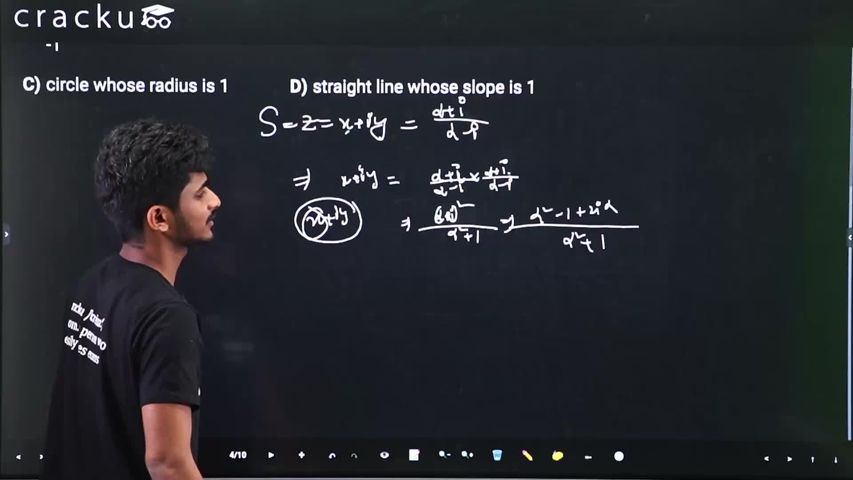
All the points in the set $$S = \left\{\frac{\alpha + i}{\alpha - i}, \alpha \in R\right\}$$, $$i = \sqrt{-1}$$ lie on a:
Let us denote the typical element of the set by $$z$$, so we write
$$z=\frac{\alpha+i}{\alpha-i},\qquad\alpha\in\mathbb R,\qquad i=\sqrt{-1}.$$
Because we finally want the locus of $$z$$ in the Argand plane, we set
$$z=x+iy,\qquad x,y\in\mathbb R.$$
We first clear the fraction by cross-multiplication:
$$z(\alpha-i)=\alpha+i.$$
Expanding the left side, we have
$$\alpha z-iz=\alpha+i.$$
Now we isolate $$\alpha$$ because in the end we shall impose “$$\alpha$$ is real” as a condition:
$$\alpha z-\alpha=i+iz$$
$$\alpha(z-1)=i(1+z).$$
Therefore
$$\alpha=\frac{i\,(1+z)}{\,z-1\,}.$$
Since $$\alpha$$ is real, the complex quotient on the right must itself be a real number. A standard test for a complex number to be real is that its imaginary part must vanish. To evaluate that imaginary part we substitute $$z=x+iy$$:
$$1+z=(1+x)+iy,$$
$$z-1=(x-1)+iy.$$
Next we multiply the numerator by $$i$$:
$$i(1+z)=i[(1+x)+iy]=i(1+x)+i(iy)=i(1+x)-y.$$
Thus, in rectangular form,
$$i(1+z)=-y+i(1+x).$$
Putting the pieces together, the expression for $$\alpha$$ becomes
$$\alpha=\frac{-y+i(1+x)}{(x-1)+iy}.$$
To test whether this quotient is real, we multiply numerator and denominator by the conjugate of the denominator; the real denominator then does not affect the “imaginary-part = 0” criterion. Hence we examine
$$\bigl[-y+i(1+x)\bigr]\bigl[(x-1)-iy\bigr].$$
We expand this product term by term:
First part: $$(-y)(x-1)=-y(x-1).$$
Second part: $$(-y)(-iy)=i\,y^{2}.$$
Third part: $$i(1+x)(x-1)=i(1+x)(x-1).$$
Fourth part: $$i(1+x)(-iy)=-(1+x)y(-1)=+(1+x)y.$$
Collecting real and imaginary components we get
Real part: $$-y(x-1)+(1+x)y=(1+x)y-y(x-1)=y[(1+x)-(x-1)]=y[1+x-x+1]=2y.$$
Imaginary part: $$i\bigl[y^{2}+(1+x)(x-1)\bigr].$$
For $$\alpha$$ to be real, the imaginary part must be zero, so we impose
$$y^{2}+(1+x)(x-1)=0.$$
We now expand the product inside the brackets:
$$(1+x)(x-1)=x^{2}-1.$$
Substituting, the condition becomes
$$y^{2}+x^{2}-1=0,$$
or, after re-arranging,
$$x^{2}+y^{2}=1.$$
This is the standard equation of a circle centred at the origin with radius $$1$$.
Hence, the points $$z=\dfrac{\alpha+i}{\alpha-i}$$ with real $$\alpha$$ all lie on the circle $$x^{2}+y^{2}=1$$, whose radius equals $$1$$.
Hence, the correct answer is Option C.
Was this solution helpful?
Click on the Email ☝️ to Watch the Video Solution
Create a FREE account and get:
_1.webp)

Educational materials for JEE preparation

Ask our AI anything

AI can make mistakes. Please verify important information.
AI can make mistakes. Please verify important information.
