
Join Our JEE Preparation Group
Prep with like-minded aspirants; Get access to free daily tests and study material.
Sign in
Please select an account to continue using cracku.in
↓ →
Join Our JEE Preparation Group
Prep with like-minded aspirants; Get access to free daily tests and study material.
The figure shows a Young's double slit experimental setup. It is observed that when a thin transparent sheet of thickness t and refractive index $$\mu$$ is put in front of one of the slits, the central maximum gets shifted by a distance equal to n fringe width. If the wavelength of light used is $$\lambda$$ then t will be:
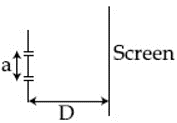
Step-by-Step Derivation
1. Shift due to a Transparent Sheet
When a transparent sheet of thickness $$t$$ and refractive index $$\mu$$ is introduced in front of one of the slits, it introduces an additional optical path difference ($$\Delta x$$) given by:
$$\Delta x = (\mu - 1)t$$
Due to this path difference, the entire fringe pattern shifts on the screen. The linear shift of the central maximum ($$\Delta y$$) is given by the formula:
$$\Delta y = \frac{D}{a}(\mu - 1)t$$
Where:
2. Relating the Shift to Fringe Width
The width of a single fringe ($$\beta$$) in Young's double slit experiment is defined as:
$$\beta = \frac{D\lambda}{a}$$
According to the problem statement, the central maximum shifts by a distance equal to $$n$$ fringe widths:
$$\Delta y = n\beta$$
3. Equating and Finding Thickness ($$t$$)
Substitute the expressions for $$\Delta y$$ and $$\beta$$ into the equation:
$$\frac{D}{a}(\mu - 1)t = n \left(\frac{D\lambda}{a}\right)$$
We can cancel out the common terms $$\frac{D}{a}$$ from both sides of the equation:
$$(\mu - 1)t = n\lambda$$
Solving for the thickness $$t$$:
$$t = \frac{n\lambda}{\mu - 1}$$
Correct Answer
The correct option is (2) $$\frac{n\lambda}{\mu - 1}$$.
Was this solution helpful?
Create a FREE account and get:
_1.webp)

Educational materials for JEE preparation

Ask our AI anything

AI can make mistakes. Please verify important information.
AI can make mistakes. Please verify important information.
