
Join Our JEE Preparation Group
Prep with like-minded aspirants; Get access to free daily tests and study material.
Sign in
Please select an account to continue using cracku.in
↓ →
Join Our JEE Preparation Group
Prep with like-minded aspirants; Get access to free daily tests and study material.
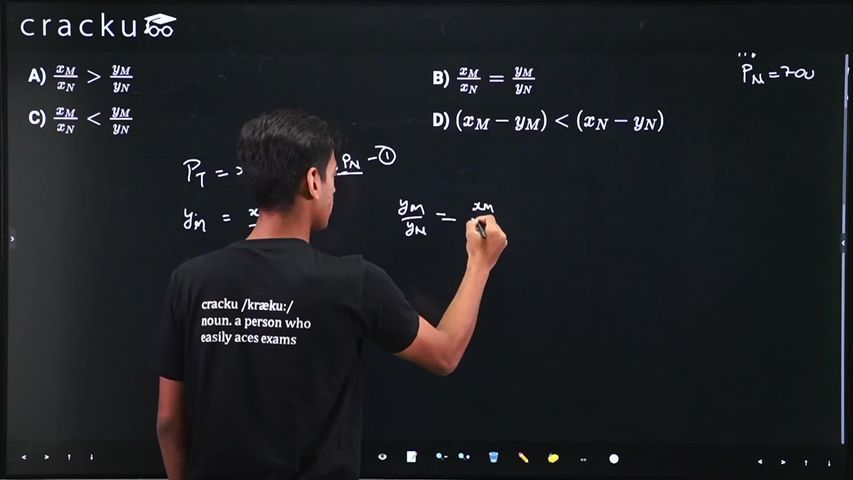
Liquid M and liquid N form an ideal solution. The vapour pressures of pure liquids M and N are 450 and 700 mmHg, respectively, at the same temperature. Then correct statements is:
(x$$_M$$ = Mole fraction of 'M' in solution; x$$_N$$ = Mole fraction of 'N' in solution; y$$_M$$ = Mole fraction of 'M' in vapour phase; y$$_N$$ = Mole fraction of 'N' in vapour phase)
We begin by recalling Raoult’s law for an ideal binary solution. It states:
$$P_M = x_M\,P_M^{\!*} \quad\text{and}\quad P_N = x_N\,P_N^{\!*}$$
where $$P_M$$ and $$P_N$$ are the partial vapour pressures of components $$M$$ and $$N$$, $$x_M$$ and $$x_N$$ are their mole fractions in the liquid phase, and $$P_M^{\!*}$$ and $$P_N^{\!*}$$ are the vapour pressures of the pure liquids at the same temperature.
We are given:
$$P_M^{\!*}=450\;\text{mmHg}, \qquad P_N^{\!*}=700\;\text{mmHg}$$
Now the total vapour pressure of the solution is the sum of the partial pressures:
$$P_{\text{total}} = P_M + P_N = x_M P_M^{\!*} + x_N P_N^{\!*} = 450\,x_M + 700\,x_N$$
The mole fraction of each component in the vapour phase is obtained from Dalton’s law of partial pressures:
$$y_M = \frac{P_M}{P_{\text{total}}}, \qquad y_N = \frac{P_N}{P_{\text{total}}}$$
Substituting the expressions for $$P_M$$ and $$P_N$$ just found, we get
$$y_M = \frac{x_M P_M^{\!*}}{x_M P_M^{\!*} + x_N P_N^{\!*}} = \frac{450\,x_M}{450\,x_M + 700\,x_N}$$
and
$$y_N = \frac{x_N P_N^{\!*}}{x_M P_M^{\!*} + x_N P_N^{\!*}} = \frac{700\,x_N}{450\,x_M + 700\,x_N}$$
We now form the ratio of the vapour-phase mole fractions:
$$\frac{y_M}{y_N} \;=\; \frac{ \dfrac{450\,x_M}{450\,x_M + 700\,x_N} }{ \dfrac{700\,x_N}{450\,x_M + 700\,x_N} }$$
The common denominator $$450\,x_M + 700\,x_N$$ cancels out, leaving
$$\frac{y_M}{y_N} = \frac{450\,x_M}{700\,x_N}$$
We separate the numerical factor from the mole-fraction ratio:
$$\frac{y_M}{y_N} = \frac{450}{700}\;\frac{x_M}{x_N}$$
The fraction $$\frac{450}{700}$$ simplifies to $$\frac{9}{14}$$, and numerically it equals $$0.642857\ldots$$ which is clearly less than $$1$$. Thus
$$\frac{y_M}{y_N} = \left(\frac{9}{14}\right)\frac{x_M}{x_N}$$
Because $$\dfrac{9}{14} < 1$$, the above equation can be rearranged to
$$\frac{x_M}{x_N} > \frac{y_M}{y_N}$$
This inequality is independent of the actual composition (as long as $$0 < x_M, x_N < 1$$ and $$x_M + x_N = 1$$). Therefore, the correct qualitative statement among the given options is
$$\frac{x_M}{x_N} > \frac{y_M}{y_N}$$
This corresponds to Option A.
Hence, the correct answer is Option A.
Was this solution helpful?
Click on the Email ☝️ to Watch the Video Solution
Create a FREE account and get:
_1.webp)

Educational materials for JEE preparation

Ask our AI anything

AI can make mistakes. Please verify important information.
AI can make mistakes. Please verify important information.
