
Join Our JEE Preparation Group
Prep with like-minded aspirants; Get access to free daily tests and study material.
Sign in
Please select an account to continue using cracku.in
↓ →
Join Our JEE Preparation Group
Prep with like-minded aspirants; Get access to free daily tests and study material.
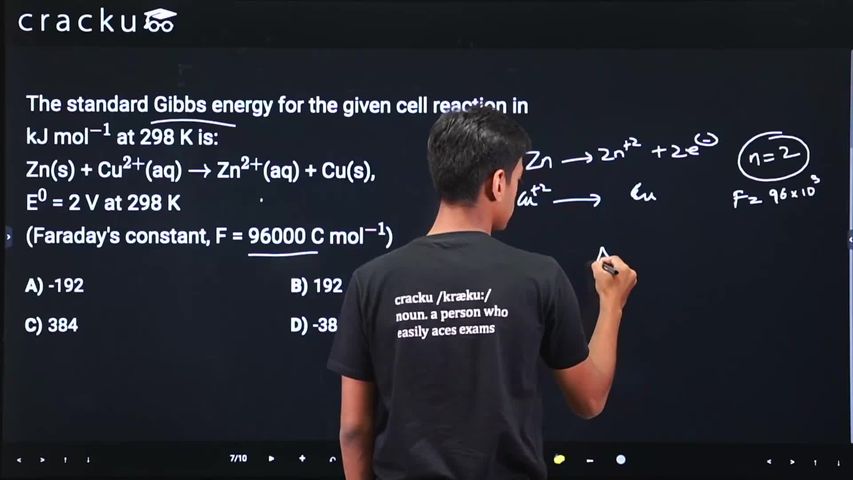
The standard Gibbs energy for the given cell reaction in kJ mol$$^{-1}$$ at 298 K is:
Zn(s) + Cu$$^{2+}$$(aq) $$\rightarrow$$ Zn$$^{2+}$$(aq) + Cu(s),
E$$^0$$ = 2 V at 298 K
(Faraday's constant, F = 96000 C mol$$^{-1}$$)
We have to connect the standard cell potential with the standard Gibbs energy change. The thermodynamic relation that links these two quantities is stated as:
$$\Delta G^{\circ} = -\,n\,F\,E^{\circ}$$
Here,
$$n$$ is the number of electrons transferred in the balanced redox reaction,
$$F$$ is Faraday’s constant $$\bigl(F = 96000 \text{ C mol}^{-1}\bigr)$$,
$$E^{\circ}$$ is the standard cell potential.
Now we first determine $$n$$ for the given cell reaction:
$$\text{Zn(s)} \;+\; \text{Cu}^{2+}(aq) \;\longrightarrow\; \text{Zn}^{2+}(aq) \;+\; \text{Cu(s)}$$
In this reaction, zinc is oxidised from the 0 oxidation state to $$+2$$, therefore it loses two electrons. Simultaneously, copper(II) ion is reduced from $$+2$$ to $$0$$, thus it gains those two electrons. Hence, the total number of electrons transferred is
$$n = 2$$
Substituting the known values into the formula:
$$\Delta G^{\circ} = -\,\bigl(2\bigr)\,\bigl(96000\text{ C mol}^{-1}\bigr)\,\bigl(2\text{ V}\bigr)$$
We multiply step by step. First the constants:
$$2 \times 96000 = 192000$$
and then include the potential:
$$192000 \times 2 = 384000$$
Applying the negative sign from the formula, we obtain
$$\Delta G^{\circ} = -\,384000 \text{ J mol}^{-1}$$
Now we convert joules to kilojoules because the options are expressed in kJ mol$$^{-1}$$:
$$\Delta G^{\circ} = \frac{-384000}{1000} = -384 \text{ kJ mol}^{-1}$$
So the standard Gibbs energy change for the given cell reaction at 298 K is $$-384 \text{ kJ mol}^{-1}$$.
Hence, the correct answer is Option D.
Was this solution helpful?
Click on the Email ☝️ to Watch the Video Solution
Create a FREE account and get:
_1.webp)

Educational materials for JEE preparation

Ask our AI anything

AI can make mistakes. Please verify important information.
AI can make mistakes. Please verify important information.
