
Join Our JEE Preparation Group
Prep with like-minded aspirants; Get access to free daily tests and study material.
Sign in
Please select an account to continue using cracku.in
↓ →
Join Our JEE Preparation Group
Prep with like-minded aspirants; Get access to free daily tests and study material.
We begin by recalling the general way to describe any colloid. A colloid consists of two distinct phases: a dispersed phase (sometimes called the discontinuous phase) and a dispersion medium (the continuous phase). Symbolically we can write a colloid as $$\text{(dispersed phase)} / \text{(dispersion medium)}.$$ What matters is which substance is finely divided and which substance surrounds it.
There are several special names for different combinations. For example, when a liquid is dispersed in another liquid, the colloid is called an emulsion; when a solid is dispersed in a liquid, it is called a sol; and when a gas is dispersed in a liquid, we get a foam. In a similar fashion, when the dispersion medium is a gas, we use the term aerosol. Thus, by definition, an aerosol is a colloid whose dispersion medium is gaseous.
Now, within aerosols we can still have two possibilities for the dispersed phase:
1. The dispersed phase can be a liquid (for example, the fine liquid droplets in mist or fog).
2. The dispersed phase can be a solid (for example, the fine soot particles in smoke).
Hence, an aerosol is either $$\text{liquid} / \text{gas}$$ or $$\text{solid} / \text{gas}.$$ In both sub-cases, the key identifying feature is that gas is the continuous medium.
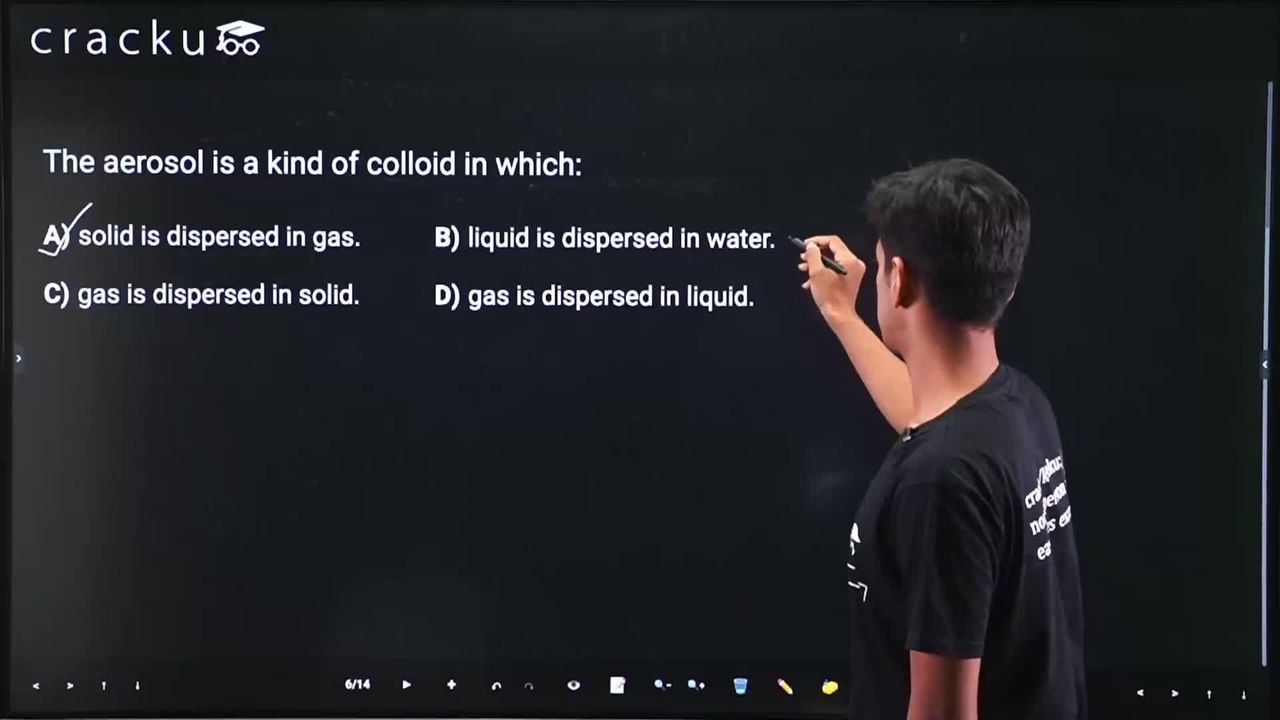
Looking at the options provided:
A. solid is dispersed in gas $$\bigl(\text{solid} / \text{gas}\bigr)$$
B. liquid is dispersed in water $$\bigl(\text{liquid} / \text{liquid}\bigr)$$ → this is an emulsion, not an aerosol.
C. gas is dispersed in solid $$\bigl(\text{gas} / \text{solid}\bigr)$$ → this is usually called a solid foam.
D. gas is dispersed in liquid $$\bigl(\text{gas} / \text{liquid}\bigr)$$ → this is an ordinary foam, again not an aerosol.
Only option A matches the defining requirement that the dispersion medium is a gas and the dispersed phase is either solid or liquid. Option A specifically gives the combination $$\text{solid} / \text{gas},$$ which is one of the two textbook examples of an aerosol (the other being $$\text{liquid} / \text{gas}$$ such as fog). Therefore, option A correctly identifies the nature of an aerosol.
Hence, the correct answer is Option A.
Was this solution helpful?
Click on the Email ☝️ to Watch the Video Solution
Create a FREE account and get:
_1.webp)

Educational materials for JEE preparation

Ask our AI anything

AI can make mistakes. Please verify important information.
AI can make mistakes. Please verify important information.
