
Join Our JEE Preparation Group
Prep with like-minded aspirants; Get access to free daily tests and study material.
Sign in
Please select an account to continue using cracku.in
↓ →
Join Our JEE Preparation Group
Prep with like-minded aspirants; Get access to free daily tests and study material.
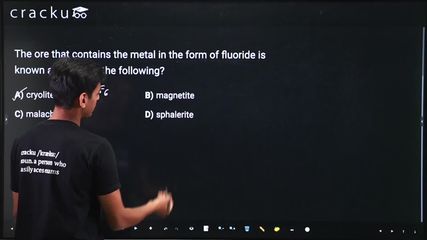
The ore that contains the metal in the form of fluoride is known as which of the following?
We are asked to identify the ore in which the metal is present as a fluoride. In other words, we need the option whose chemical composition clearly shows the presence of the fluoride ion $$\mathrm{F^-}$$ bound to a metal cation.
First, let us write the formulae of all the given ores:
• Cryolite $$\mathrm{Na_3AlF_6}$$
• Magnetite $$\mathrm{Fe_3O_4}$$
• Malachite $$\mathrm{CuCO_3\!\cdot\!Cu(OH)_2}$$
• Sphalerite $$\mathrm{ZnS}$$
Now, we inspect each formula:
• In $$\mathrm{Na_3AlF_6}$$ we clearly see the presence of six fluoride ions $$\mathrm{F^-}$$ combined with sodium and aluminium. So cryolite is a fluoride ore.
• In $$\mathrm{Fe_3O_4}$$ we only have the oxide ion $$\mathrm{O^{2-}}$$, hence magnetite is an oxide ore.
• In $$\mathrm{CuCO_3\!\cdot\!Cu(OH)_2}$$ we see carbonate $$\mathrm{CO_3^{2-}}$$ and hydroxide $$\mathrm{OH^-}$$ ions, so malachite is a basic copper carbonate, not a fluoride.
• In $$\mathrm{ZnS}$$ the anion present is sulfide $$\mathrm{S^{2-}}$$, therefore sphalerite is a sulfide ore.
Only cryolite satisfies the requirement of containing the metal in the form of a fluoride.
Hence, the correct answer is Option A.
Was this solution helpful?
Click on the Email ☝️ to Watch the Video Solution
Create a FREE account and get:
_1.webp)

Educational materials for JEE preparation

Ask our AI anything

AI can make mistakes. Please verify important information.
AI can make mistakes. Please verify important information.
