
Join Our JEE Preparation Group
Prep with like-minded aspirants; Get access to free daily tests and study material.
Sign in
Please select an account to continue using cracku.in
↓ →
Join Our JEE Preparation Group
Prep with like-minded aspirants; Get access to free daily tests and study material.
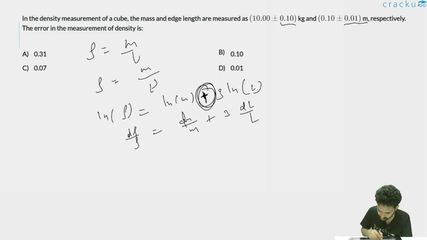
In the density measurement of a cube, the mass and edge length are measured as $$(10.00 \pm 0.10)$$ kg and $$(0.10 \pm 0.01)$$ m, respectively. The error in the measurement of density is:
We have a cube whose mass is given as $$m = 10.00 \ \text{kg} \pm 0.10 \ \text{kg}$$ and whose edge length is $$l = 0.10 \ \text{m} \pm 0.01 \ \text{m}$$. We wish to find the percentage (or fractional) error in its density.
First, recall the formula connecting mass, volume and density. Density is defined by
$$\rho = \frac{m}{V}.$$
Because the body is a cube, its volume is the cube of its edge length, so
$$V = l^3.$$
Substituting this expression for volume in the density definition gives
$$\rho = \frac{m}{l^3}.$$
When we need the error in a quantity which is a product or quotient of measured quantities raised to powers, we employ the law of propagation of relative (or fractional) errors:
If $$Q = a^p b^q$$, then the relative error in $$Q$$ is
$$\frac{\Delta Q}{Q} = |p|\frac{\Delta a}{a} + |q|\frac{\Delta b}{b}.$$
In our present case $$\rho = m \, l^{-3}$$, so the exponents are $$+1$$ for $$m$$ and $$-3$$ for $$l$$. Only their magnitudes matter. Thus the relative error in density is
$$\frac{\Delta \rho}{\rho} = 1 \times \frac{\Delta m}{m} + 3 \times \frac{\Delta l}{l}.$$
We now compute each individual relative error:
For mass,
$$\frac{\Delta m}{m} = \frac{0.10}{10.00} = 0.010.$$
For length,
$$\frac{\Delta l}{l} = \frac{0.01}{0.10} = 0.10.$$
Substituting these values into the propagation formula, we get
$$\frac{\Delta \rho}{\rho} = 0.010 + 3 \times 0.10.$$
Multiplying out the second term,
$$0.010 + 0.30 = 0.310.$$
Therefore the fractional (or percentage, if multiplied by 100) error in the measurement of density is
$$\frac{\Delta \rho}{\rho} = 0.31.$$
Since the options list numerical values of the error without units, the answer corresponds to $$0.31$$.
Hence, the correct answer is Option A.
Was this solution helpful?
Click on the Email ☝️ to Watch the Video Solution
Create a FREE account and get:
_1.webp)

Educational materials for JEE preparation

Ask our AI anything

AI can make mistakes. Please verify important information.
AI can make mistakes. Please verify important information.
