
Join Our JEE Preparation Group
Prep with like-minded aspirants; Get access to free daily tests and study material.
Sign in
Please select an account to continue using cracku.in
↓ →
Join Our JEE Preparation Group
Prep with like-minded aspirants; Get access to free daily tests and study material.
A body of mass 2 kg makes an elastic collision with a second body at rest and continues to move in the original direction but with one fourth of its original speed. What is the mass of the second body?
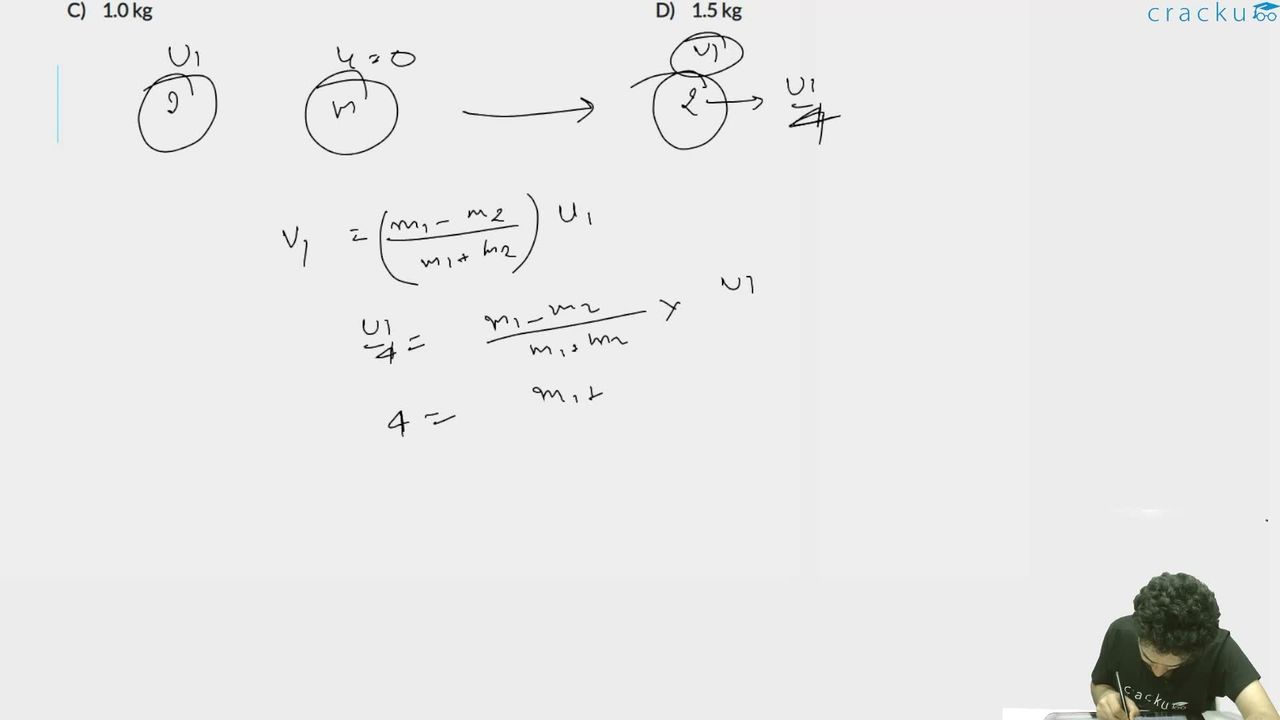
Let the mass of the projectile (first body) be $$m_1 = 2\ \text{kg}$$ and its initial speed be $$u_1.$$
The second body is at rest, so for it $$u_2 = 0.$$ Let its mass be $$m_2,$$ which we have to find.
After an elastic collision in one dimension we denote the final speeds by $$v_1$$ and $$v_2$$ for the first and the second bodies respectively. According to the statement, the first body continues in the same direction with one-fourth of its original speed, so
$$v_1 = \frac{u_1}{4}.$$
For a perfectly elastic head-on collision we use the standard velocity-transfer formula (derived from simultaneous conservation of linear momentum and kinetic energy):
$$v_1 \;=\; \frac{m_1 - m_2}{m_1 + m_2}\;u_1.$$
Now we substitute the known value $$v_1 = u_1/4$$ into this formula:
$$\frac{u_1}{4} \;=\; \frac{m_1 - m_2}{m_1 + m_2}\;u_1.$$
Because $$u_1 \neq 0,$$ we cancel it from both sides:
$$\frac{1}{4} \;=\; \frac{m_1 - m_2}{m_1 + m_2}.$$
Cross-multiplying gives
$$4\,(m_1 - m_2) \;=\; m_1 + m_2.$$
Expanding and bringing like terms together, we have
$$4m_1 - 4m_2 \;=\; m_1 + m_2$$
$$4m_1 - m_1 \;=\; 4m_2 + m_2$$
$$3m_1 \;=\; 5m_2.$$
Solving for $$m_2$$ yields
$$m_2 \;=\; \frac{3}{5}\,m_1.$$
Finally, substituting $$m_1 = 2\ \text{kg}$$ gives
$$m_2 \;=\; \frac{3}{5}\times 2\ \text{kg} \;=\; \frac{6}{5}\ \text{kg} \;=\; 1.2\ \text{kg}.$$
Hence, the correct answer is Option B.
Was this solution helpful?
Click on the Email ☝️ to Watch the Video Solution
Create a FREE account and get:
_1.webp)

Educational materials for JEE preparation

Ask our AI anything

AI can make mistakes. Please verify important information.
AI can make mistakes. Please verify important information.
