
Join Our JEE Preparation Group
Prep with like-minded aspirants; Get access to free daily tests and study material.
Sign in
Please select an account to continue using cracku.in
↓ →
Join Our JEE Preparation Group
Prep with like-minded aspirants; Get access to free daily tests and study material.
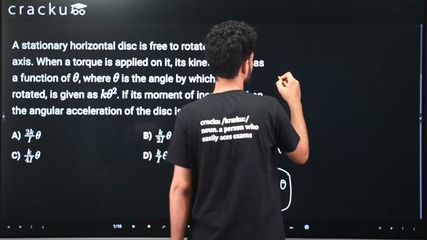
A stationary horizontal disc is free to rotate about its axis. When a torque is applied on it, its kinetic energy as a function of $$\theta$$, where $$\theta$$ is the angle by which it has rotated, is given as $$k\theta^2$$. If its moment of inertia is I then the angular acceleration of the disc is:
We are told that the rotational kinetic energy of the disc depends on the angular displacement $$\theta$$ according to the relation $$K = k\theta^{2}$$, where $$k$$ is a constant.
The general formula for rotational kinetic energy is first recalled: $$K = \dfrac{1}{2}\,I\,\omega^{2},$$ where $$I$$ is the moment of inertia of the disc and $$\omega$$ is its instantaneous angular speed.
Equating the given expression for $$K$$ with the standard formula, we have $$\dfrac{1}{2}\,I\,\omega^{2} = k\theta^{2}.$$
We solve this equation for $$\omega$$ step by step:
Multiplying both sides by $$2$$ gives $$I\,\omega^{2} = 2k\theta^{2}.$$
Dividing both sides by $$I$$ yields $$\omega^{2} = \dfrac{2k}{I}\,\theta^{2}.$$
Taking the positive square root (because speed is taken as positive) gives $$\omega = \sqrt{\dfrac{2k}{I}}\;\theta.$$
Now we need the angular acceleration $$\alpha$$. By definition, $$\alpha = \dfrac{d\omega}{dt}.$$
Because $$\omega$$ is expressed as a function of $$\theta$$, we use the chain rule: $$\alpha = \dfrac{d\omega}{d\theta}\;\dfrac{d\theta}{dt}.$$ But $$\dfrac{d\theta}{dt}$$ is exactly $$\omega$$ itself, so $$\alpha = \left(\dfrac{d\omega}{d\theta}\right)\omega.$$
We next compute $$\dfrac{d\omega}{d\theta}$$ from the expression $$\omega = \sqrt{\dfrac{2k}{I}}\;\theta$$. Differentiating with respect to $$\theta$$ gives $$\dfrac{d\omega}{d\theta} = \sqrt{\dfrac{2k}{I}}.$$
Substituting this derivative and $$\omega$$ back into the chain-rule expression, we get $$\alpha = \sqrt{\dfrac{2k}{I}}\;\times\;\left(\sqrt{\dfrac{2k}{I}}\;\theta\right) = \left(\dfrac{2k}{I}\right)\theta.$$
Thus the angular acceleration is $$\boxed{\alpha = \dfrac{2k}{I}\,\theta}.$$
By comparing with the given choices, this matches Option A.
Hence, the correct answer is Option A.
Was this solution helpful?
Click on the Email ☝️ to Watch the Video Solution
Create a FREE account and get:
_1.webp)

Educational materials for JEE preparation

Ask our AI anything

AI can make mistakes. Please verify important information.
AI can make mistakes. Please verify important information.
