
Join Our JEE Preparation Group
Prep with like-minded aspirants; Get access to free daily tests and study material.
Sign in
Please select an account to continue using cracku.in
↓ →
Join Our JEE Preparation Group
Prep with like-minded aspirants; Get access to free daily tests and study material.
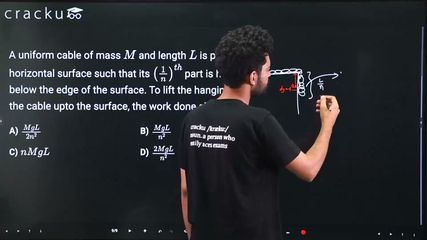
A uniform cable of mass $$M$$ and length $$L$$ is placed on a horizontal surface such that its $$\left(\frac{1}{n}\right)^{th}$$ part is hanging below the edge of the surface. To lift the hanging part of the cable upto the surface, the work done should be:
Let us begin by noting that the cable is uniform, so its mass per unit length (linear mass density) is constant. We denote this density by $$\lambda$$ and write
$$\lambda \;=\;\frac{M}{L},$$
because the total mass $$M$$ is uniformly distributed along the total length $$L$$.
According to the statement, a fraction $$\left(\frac{1}{n}\right)^{\!th}$$ of the cable hangs below the horizontal surface. Hence the vertical length that is hanging is
$$\ell_h \;=\;\frac{L}{n}.$$
We choose the horizontal surface as the reference level $$y = 0$$. Positive $$y$$ is taken upward, so the hanging portion originally lies at negative values of $$y$$. Every small element of cable located at a distance $$y$$ below the surface (that is, at $$y$$ between $$-\,\frac{L}{n}$$ and $$0$$) has to be raised through a height equal to the absolute value of its initial coordinate, namely $$|y| = -y$$.
Let us label a small element of length $$dy$$ on the hanging part. Its mass is
$$dm \;=\;\lambda\,dy \;=\;\frac{M}{L}\,dy.$$
Initially this element is at a coordinate $$y$$ (negative), so it must be lifted through a vertical distance $$h = -y$$ to reach the surface. The elementary work $$dW$$ required to lift this element is given by the basic work formula
$$dW \;=\;(\text{force})\times(\text{displacement}) \;=\; (dm\,g)\,h.$$
Substituting $$dm$$ and $$h$$, we have
$$dW \;=\;\left(\frac{M}{L}\,dy\right)g\,(-y) \;=\;-\frac{M g}{L}\,y\,dy.$$
Because $$y$$ runs from $$-\frac{L}{n}$$ (bottom of the hanging part) up to $$0$$ (surface), the total work $$W$$ is obtained by integrating $$dW$$ over this interval:
$$W \;=\;\int_{y=-L/n}^{\,0} \left(-\frac{M g}{L}\,y\right)\,dy.$$
We now carry out the algebraic steps of the integration:
$$W \;=\;-\frac{M g}{L}\int_{-L/n}^{\,0} y\,dy \;=\;-\frac{M g}{L}\left[\,\frac{y^{2}}{2}\,\right]_{-L/n}^{\,0}.$$
Evaluating the definite integral, we get
$$\left[\,\frac{y^{2}}{2}\,\right]_{-L/n}^{\,0} \;=\;\frac{(0)^{2}}{2} \;-\;\frac{\left(-\dfrac{L}{n}\right)^{2}}{2} \;=\;0 \;-\;\frac{L^{2}}{2n^{2}} \;=\;-\frac{L^{2}}{2n^{2}}.$$
Substituting this back,
$$W \;=\;-\frac{M g}{L}\left(-\frac{L^{2}}{2n^{2}}\right) \;=\;\frac{M g}{L}\,\frac{L^{2}}{2n^{2}} \;=\;\frac{M g L}{2n^{2}}.$$
Thus the work needed to raise the entire hanging part of the cable to the level of the surface is
$$W \;=\;\frac{M g L}{2 n^{2}}.$$
Comparing this result with the given options, we see that it matches Option A.
Hence, the correct answer is Option A.
Was this solution helpful?
Click on the Email ☝️ to Watch the Video Solution
Create a FREE account and get:
_1.webp)

Educational materials for JEE preparation

Ask our AI anything

AI can make mistakes. Please verify important information.
AI can make mistakes. Please verify important information.
