
Join Our JEE Preparation Group
Prep with like-minded aspirants; Get access to free daily tests and study material.
Sign in
Please select an account to continue using cracku.in
↓ →
Join Our JEE Preparation Group
Prep with like-minded aspirants; Get access to free daily tests and study material.
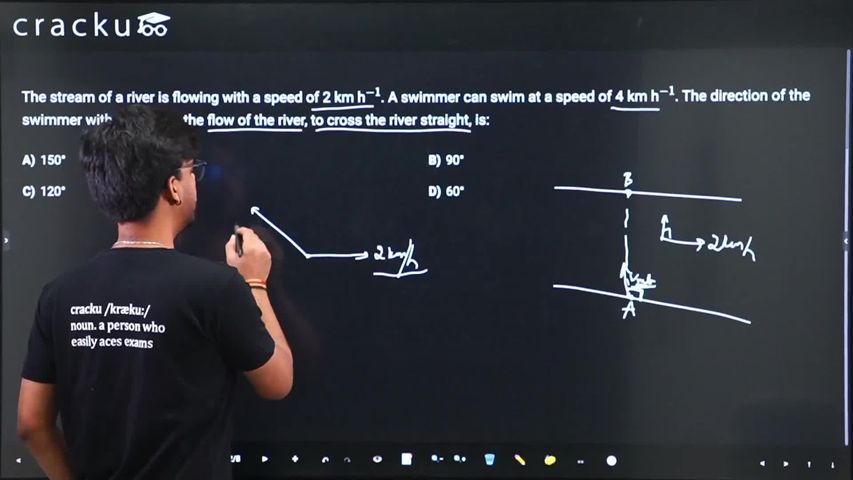
The stream of a river is flowing with a speed of 2 km h$$^{-1}$$. A swimmer can swim at a speed of 4 km h$$^{-1}$$. The direction of the swimmer with respect to the flow of the river, to cross the river straight, is:
We have a river whose water is flowing in a straight line with a velocity $$\vec v_r = 2\;{\rm km\,h^{-1}}$$. We may imagine this flow to be along the positive $$x$$-axis.
The swimmer is able to propel himself through still water with a speed $$\lvert \vec v_s\rvert = 4\;{\rm km\,h^{-1}}$$. He can choose any direction; let him make an angle $$\theta$$ with the direction of flow of the river. Thus, measured from the positive $$x$$-axis (down-stream direction), his velocity relative to the water can be written in component form as
$$ \vec v_s = 4\cos\theta\,\hat i + 4\sin\theta\,\hat j, $$
where $$\hat i$$ is the unit vector along the flow (east), and $$\hat j$$ is the unit vector pointing straight across the river towards the opposite bank (north).
The actual or ground velocity of the swimmer, which we shall denote by $$\vec v_{g}$$, is obtained by vector addition of the river velocity and the swimmer’s velocity relative to water:
$$ \vec v_{g} \;=\; \vec v_r + \vec v_s \;=\; (2\,\hat i) + \bigl(4\cos\theta\,\hat i + 4\sin\theta\,\hat j\bigr) \;=\; (2 + 4\cos\theta)\,\hat i + 4\sin\theta\,\hat j. $$
To cross the river straight—that is, to reach the point on the opposite bank directly opposite to his starting point—the swimmer’s resultant velocity must point purely across the river. In mathematical terms, the $$x$$-component of $$\vec v_{g}$$ must vanish:
$$ 2 + 4\cos\theta \;=\; 0. $$
Solving for $$\cos\theta$$ gives
$$ \cos\theta \;=\; -\,\frac{2}{4} \;=\; -\frac12. $$
We recall the standard trigonometric result that $$\cos120^\circ = -\dfrac12$$. Hence,
$$ \theta \;=\; 120^\circ. $$
This angle is measured from the direction of the river’s flow and points upstream (because the cosine is negative), exactly the orientation needed to cancel the down-stream drift.
So the swimmer must head at an angle of $$120^\circ$$ with respect to the flow of the river.
Hence, the correct answer is Option C.
Was this solution helpful?
Click on the Email ☝️ to Watch the Video Solution
Create a FREE account and get:
_1.webp)

Educational materials for JEE preparation

Ask our AI anything

AI can make mistakes. Please verify important information.
AI can make mistakes. Please verify important information.
