
Join Our JEE Preparation Group
Prep with like-minded aspirants; Get access to free daily tests and study material.
Sign in
Please select an account to continue using cracku.in
↓ →
Join Our JEE Preparation Group
Prep with like-minded aspirants; Get access to free daily tests and study material.
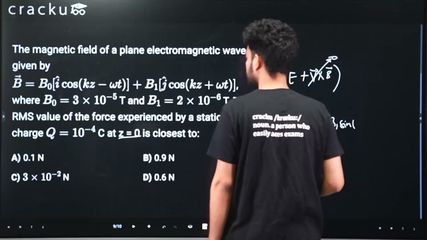
The magnetic field of a plane electromagnetic wave is given by $$\vec{B} = B_0[\hat{i}\cos(kz - \omega t)] + B_1[\hat{j}\cos(kz + \omega t)]$$, where $$B_0 = 3 \times 10^{-5}$$ T and $$B_1 = 2 \times 10^{-6}$$ T. The RMS value of the force experienced by a stationary charge $$Q = 10^{-4}$$ C at z = 0 is closest to:
We begin with the Lorentz force formula for a charge kept at rest. The general expression is
$$\vec{F}=Q\bigl(\vec{E}+\vec{v}\times\vec{B}\bigr).$$
Because the charge is stationary, we have $$\vec{v}=0$$, so the magnetic part vanishes and only the electric field contributes:
$$\vec{F}=Q\,\vec{E}.$$
The magnetic field given in the problem is
$$\vec{B}=B_0\,\hat i\cos(kz-\omega t)+B_1\,\hat j\cos(kz+\omega t).$$
For an electromagnetic wave in free space, the magnitudes of the electric and magnetic fields are related by the well-known relation
$$E=cB,$$
where $$c=3\times10^{8}\ \text{m s}^{-1}$$ is the speed of light. This relation holds point by point and at every instant of time.
We are asked for the force at the spatial point $$z=0$$. Putting $$z=0$$ in the expression for $$\vec B$$ gives
$$\vec{B}(0,t)=B_0\,\hat i\cos(\!-\omega t)+B_1\,\hat j\cos(\omega t).$$
Since $$\cos(-\omega t)=\cos(\omega t),$$ the two cosine factors are identical, and we can write
$$\vec{B}(0,t)=\cos(\omega t)\bigl(B_0\,\hat i+B_1\,\hat j\bigr).$$
The magnitude of this magnetic field is therefore
$$B(0,t)=\bigl|\vec{B}(0,t)\bigr|=\cos(\omega t)\sqrt{B_0^{\,2}+B_1^{\,2}}.$$
Invoking $$E=cB$$ at the same point gives the magnitude of the electric field:
$$E(0,t)=c\,B(0,t)=c\,\cos(\omega t)\sqrt{B_0^{\,2}+B_1^{\,2}}.$$
Because the force is simply $$Q$$ times the electric field, its instantaneous magnitude becomes
$$F(t)=Q\,E(0,t)=Q\,c\,\cos(\omega t)\sqrt{B_0^{\,2}+B_1^{\,2}}.$$
This is a pure cosine function of time. Its peak (maximum) value is
$$F_0=Q\,c\,\sqrt{B_0^{\,2}+B_1^{\,2}}.$$
The root-mean-square (RMS) value of any quantity of the form $$A\cos(\omega t)$$ is well known to be $$A/\sqrt{2}$$. Hence the RMS force is
$$F_{\text{rms}}=\frac{F_0}{\sqrt{2}}=\frac{Q\,c}{\sqrt{2}}\sqrt{B_0^{\,2}+B_1^{\,2}}.$$
We now substitute the numerical data:
$$B_0=3\times10^{-5}\ \text{T},\qquad B_1=2\times10^{-6}\ \text{T},\qquad Q=10^{-4}\ \text{C},\qquad c=3\times10^{8}\ \text{m s}^{-1}.$$
First, the combination under the square root:
$$\begin{aligned} B_0^{\,2}&=(3\times10^{-5})^{2}=9\times10^{-10},\\ B_1^{\,2}&=(2\times10^{-6})^{2}=4\times10^{-12},\\ B_0^{\,2}+B_1^{\,2}&=9\times10^{-10}+4\times10^{-12}=9.04\times10^{-10}. \end{aligned}$$
Taking the square root,
$$\sqrt{B_0^{\,2}+B_1^{\,2}}=\sqrt{9.04\times10^{-10}}=\sqrt{9.04}\times10^{-5}\approx3.008\times10^{-5}\ \text{T}.$$
Next, compute the product $$Q\,c$$:
$$Q\,c=10^{-4}\times3\times10^{8}=3\times10^{4}.$$
Therefore the peak force is
$$F_0=(3\times10^{4})(3.008\times10^{-5})=9.024\times10^{-1}\ \text{N}\approx0.902\ \text{N}.$$
The RMS force is obtained by dividing by $$\sqrt{2}$$:
$$F_{\text{rms}}=\frac{0.902}{\sqrt{2}}=\frac{0.902}{1.414}\approx0.638\ \text{N}.$$
Comparing this value with the choices, $$0.638\ \text{N}$$ rounds to $$0.6\ \text{N}$$.
Hence, the correct answer is Option D.
Was this solution helpful?
Click on the Email ☝️ to Watch the Video Solution
Create a FREE account and get:
_1.webp)

Educational materials for JEE preparation

Ask our AI anything

AI can make mistakes. Please verify important information.
AI can make mistakes. Please verify important information.
