
Join Our JEE Preparation Group
Prep with like-minded aspirants; Get access to free daily tests and study material.
Sign in
Please select an account to continue using cracku.in
↓ →
Join Our JEE Preparation Group
Prep with like-minded aspirants; Get access to free daily tests and study material.
First, let us recall the exact structure of sucrose. It is a disaccharide formed by one unit of $$\alpha$$-D-glucopyranose and one unit of $$\beta$$-D-fructofuranose. The two monosaccharide rings are joined through a glycosidic linkage that involves the anomeric carbon $$C_1$$ of the glucose unit and the anomeric carbon $$C_2$$ of the fructose unit. Symbolically, this linkage is written as $$\alpha$$-D-Glucose $$(1 \rightarrow 2)$$ $$\beta$$-D-Fructose.
Now we examine every option one by one, comparing the statements with the above fact.
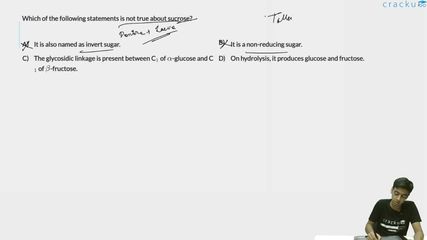
Option A: “It is also named as invert sugar.” We know that when sucrose is hydrolysed, the optical rotation of the solution changes from dextrorotatory to laevorotatory because the mixture of glucose and fructose produced has a net negative rotation. This change in sign is called inversion, and therefore sucrose is often referred to as “invert sugar.” So, Option A is a true statement.
Option B: “It is a non-reducing sugar.” Since both anomeric carbons (of glucose and fructose) are involved in the $$\alpha1 \rightarrow \beta2$$ glycosidic bond, neither ring possesses a free hemi-acetal or hemi-ketal group. As a result, sucrose cannot reduce Fehling’s solution or Tollen’s reagent and is indeed non-reducing. Therefore, Option B is also true.
Option C: “The glycosidic linkage is present between $$C_1$$ of $$\alpha$$-glucose and $$C_1$$ of $$\beta$$-fructose.” From our structural recollection we have the linkage between $$C_1$$ of $$\alpha$$-glucose and $$C_2$$ of $$\beta$$-fructose, not between the two $$C_1$$ atoms. Hence the statement given in Option C is incorrect.
Option D: “On hydrolysis, it produces glucose and fructose.” When sucrose is treated with dilute acid or the enzyme invertase, it splits into equimolar amounts of D-glucose and D-fructose. This is precisely what the option states, so Option D is correct.
We have found that only Option C conflicts with the actual chemistry of sucrose. All other options are true, while Option C is not.
Hence, the correct answer is Option C.
Was this solution helpful?
Click on the Email ☝️ to Watch the Video Solution
Create a FREE account and get:
_1.webp)

Educational materials for JEE preparation

Ask our AI anything

AI can make mistakes. Please verify important information.
AI can make mistakes. Please verify important information.
