Join Our JEE Preparation Group
Prep with like-minded aspirants; Get access to free daily tests and study material.
Sign in
Please select an account to continue using cracku.in
↓ →
Join Our JEE Preparation Group
Prep with like-minded aspirants; Get access to free daily tests and study material.
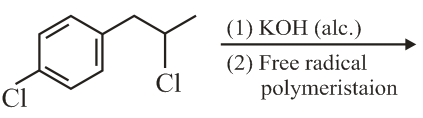
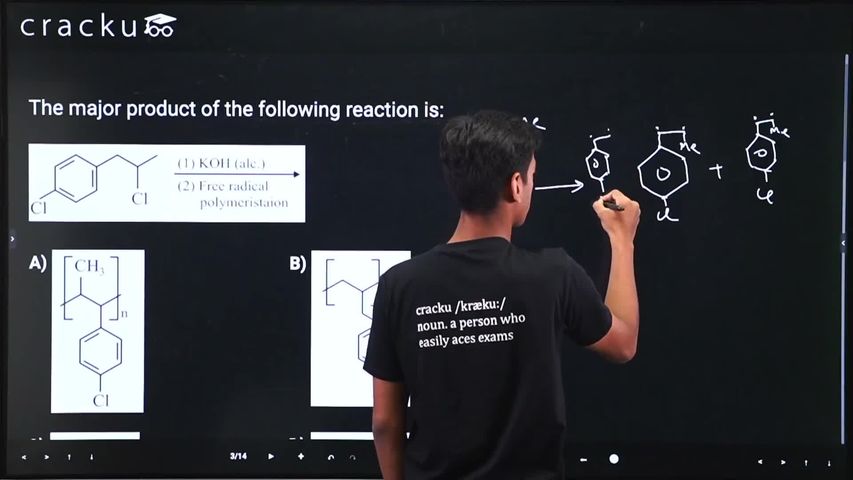
The conversion begins with 1-chloro-4-(2-chloropropyl)benzene undergoing an E2 dehydrohalogenation reaction when treated with alcoholic potassium hydroxide. The strong hydroxide base selectively abstracts a highly acidic benzylic proton from the aliphatic side chain, forcing the elimination of the adjacent chloride ion. This step yields the thermodynamically favoured intermediate, 1-chloro-4-(prop-1-en-1-yl)benzene (also known as p-chloropropenylbenzene), where the newly formed alkene double bond is highly stabilized through extended conjugation with the aromatic ring; the aryl chloride attached directly to the benzene ring remains completely unreactive due to its partial double-bond character. In the second step, this conjugated alkene intermediate undergoes free radical polymerization initiated by a thermal radical source like benzoyl peroxide or AIBN. The radical initiator adds to the alkene monomer, breaking its $\pi$-bond to generate a reactive benzylic radical that successively attacks subsequent monomer units. This continuous propagation chain link builds a high-molecular-weight polymer backbone of alternating carbon atoms, resulting in the final product: poly[1-chloro-4-(prop-1-en-1-yl)benzene]
Was this solution helpful?
Click on the Email ☝️ to Watch the Video Solution
Create a FREE account and get:
_1.webp)

Educational materials for JEE preparation

Ask our AI anything

AI can make mistakes. Please verify important information.
AI can make mistakes. Please verify important information.