Join Our JEE Preparation Group
Prep with like-minded aspirants; Get access to free daily tests and study material.
Sign in
Please select an account to continue using cracku.in
↓ →
Join Our JEE Preparation Group
Prep with like-minded aspirants; Get access to free daily tests and study material.
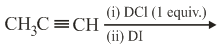
The starting material is propyne (CH3-C≡CH). It undergoes electrophilic addition with deuterium chloride (DCl) according to Markovnikov's rule.
Product after Step 1: CH3-C(Cl)=CHD (2-chloro-1-deuteropropene)
The alkene product from Step 1 now reacts with deuterium iodide (DI), again following Markovnikov's rule.
Final Product: CH3-C(Cl)(I)-CHD2
The final major product of the reaction sequence is:
CH3-C(Cl)(I)-CHD2 (2-chloro-2-iodo-1,1-diduteropropane)
Was this solution helpful?
Create a FREE account and get:
_1.webp)

Educational materials for JEE preparation

Ask our AI anything

AI can make mistakes. Please verify important information.
AI can make mistakes. Please verify important information.