
Join Our JEE Preparation Group
Prep with like-minded aspirants; Get access to free daily tests and study material.
Sign in
Please select an account to continue using cracku.in
↓ →
Join Our JEE Preparation Group
Prep with like-minded aspirants; Get access to free daily tests and study material.
We begin by noting that carbon dioxide, written chemically as $$\mathrm{CO_2}$$, is one of the principal green-house gases. Green-house gases possess the special property of allowing incoming short-wave solar radiation to enter the Earth’s atmosphere while trapping the outgoing long-wave infrared radiation emitted by the warmed surface. This trapping produces an overall rise in the mean temperature of the atmosphere.
This phenomenon is popularly called the green-house effect. When the concentration of $$\mathrm{CO_2}$$ exceeds its natural level because of activities such as the burning of fossil fuels, deforestation, and industrial processes, the strength of the green-house effect increases. As a direct consequence, the average global temperature starts to rise. This rise in temperature is termed global warming.
Now we examine each option in the question:
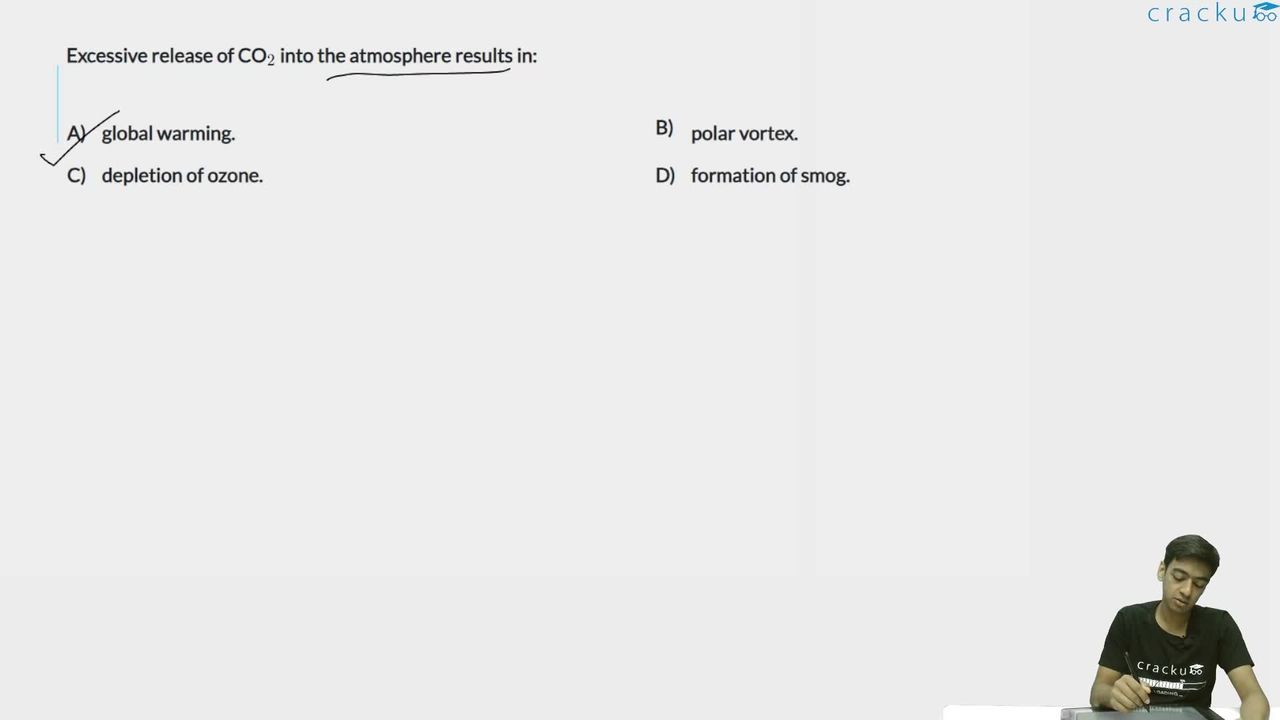
Option A states “global warming.” As just explained, an excessive release of $$\mathrm{CO_2}$$ enhances the green-house effect and therefore does lead to global warming. Hence Option A is correct.
Option B mentions a “polar vortex.” A polar vortex is a large-scale cyclone that forms over the poles primarily due to natural temperature gradients; its formation is not a direct result of higher $$\mathrm{CO_2}$$ levels, so this cannot be chosen.
Option C speaks of “depletion of ozone.” Ozone depletion is mainly caused by chlorofluorocarbons (CFCs) and related halogenated compounds, not by excess $$\mathrm{CO_2}$$. Therefore Option C is not correct.
Option D refers to “formation of smog.” Classical smog involves smoke and fog, while photochemical smog results from nitrogen oxides, volatile organic compounds, and sunlight. Again, $$\mathrm{CO_2}$$ is not the principal agent here, so Option D is also incorrect.
After evaluating all four statements, only Option A remains consistent with the well-established scientific link between high atmospheric $$\mathrm{CO_2}$$ and global temperature rise.
Hence, the correct answer is Option A.
Was this solution helpful?
Click on the Email ☝️ to Watch the Video Solution
Create a FREE account and get:
_1.webp)

Educational materials for JEE preparation

Ask our AI anything

AI can make mistakes. Please verify important information.
AI can make mistakes. Please verify important information.
