
Join Our JEE Preparation Group
Prep with like-minded aspirants; Get access to free daily tests and study material.
Sign in
Please select an account to continue using cracku.in
↓ →
Join Our JEE Preparation Group
Prep with like-minded aspirants; Get access to free daily tests and study material.
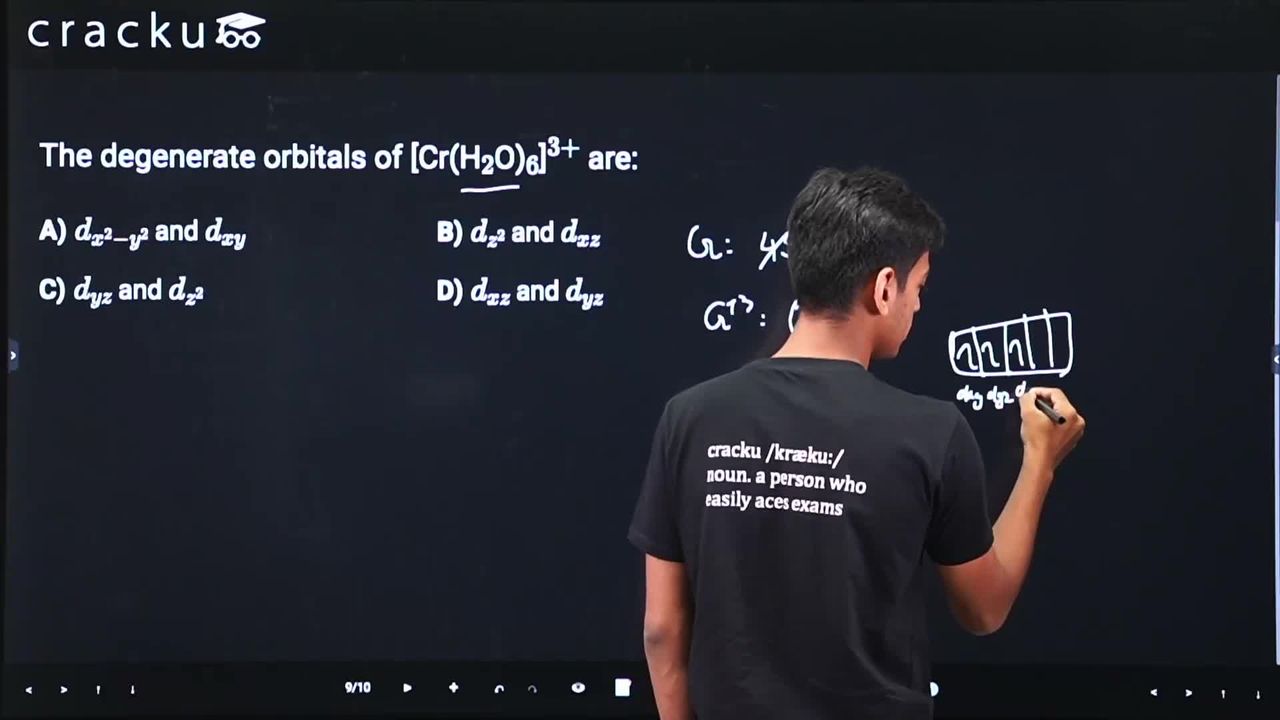
We begin by recalling the crystal-field theory statement that in an octahedral field the five $$d$$ orbitals of the central metal ion do not remain equal in energy. The electrostatic interactions with the six surrounding ligands split them into two distinct energy sets.
1. The higher-energy set is labelled $$e_g$$ and consists of the two orbitals that point directly toward the ligands along the Cartesian axes. In symbols, those are $$d_{x^2-y^2}$$ and $$d_{z^2}$$. These two orbitals are degenerate, i.e. they have exactly the same energy within the octahedral field.
2. The lower-energy set is labelled $$t_{2g}$$ and consists of the three orbitals that lie between the axes. In symbols, those are $$d_{xy},\; d_{xz},\; d_{yz}$$. All three of these orbitals are also mutually degenerate.
For the given complex $$[ \text{Cr(H}_2\text{O})_6 ]^{3+}$$ we therefore know:
$$\text{In an octahedral field:}\quad e_g = \{\,d_{x^2-y^2},\; d_{z^2}\,\}, \qquad t_{2g} = \{\,d_{xy},\; d_{xz},\; d_{yz}\,\}$$
Now we look at each option and check whether the two orbitals listed belong to the same set (only then will they be degenerate):
A. $$d_{x^2-y^2}$$ (in $$e_g$$) and $$d_{xy}$$ (in $$t_{2g}$$) - different sets, not degenerate.
B. $$d_{z^2}$$ (in $$e_g$$) and $$d_{xz}$$ (in $$t_{2g}$$) - different sets, not degenerate.
C. $$d_{yz}$$ (in $$t_{2g}$$) and $$d_{z^2}$$ (in $$e_g$$) - different sets, not degenerate.
D. $$d_{xz}$$ and $$d_{yz}$$ - both are in the $$t_{2g}$$ set, so they are degenerate.
Only Option D lists two orbitals that reside in the same crystal-field energy level, therefore only Option D gives a pair of degenerate orbitals.
Hence, the correct answer is Option 4.
Was this solution helpful?
Click on the Email ☝️ to Watch the Video Solution
Create a FREE account and get:
_1.webp)

Educational materials for JEE preparation

Ask our AI anything

AI can make mistakes. Please verify important information.
AI can make mistakes. Please verify important information.
