
Join Our JEE Preparation Group
Prep with like-minded aspirants; Get access to free daily tests and study material.
Sign in
Please select an account to continue using cracku.in
↓ →
Join Our JEE Preparation Group
Prep with like-minded aspirants; Get access to free daily tests and study material.
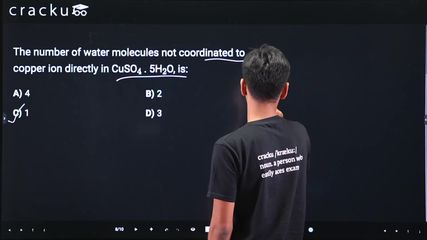
The number of water molecules not coordinated to copper ion directly in CuSO$$_4$$ . 5H$$_2$$O, is:
We need to find the number of water molecules NOT directly coordinated to the copper ion in $$CuSO_4 \cdot 5H_2O$$.
The crystal structure of copper(II) sulfate pentahydrate ($$CuSO_4 \cdot 5H_2O$$) has been well established by X-ray crystallography.
In this compound, the $$Cu^{2+}$$ ion has a coordination number of 6, forming an octahedral geometry.
The coordination sphere of $$Cu^{2+}$$ consists of:
- Four water molecules ($$H_2O$$) coordinated directly to $$Cu^{2+}$$, occupying the equatorial positions.
- Two oxygen atoms from two different sulfate ($$SO_4^{2-}$$) ions, occupying the axial positions.
This gives the structural formula: $$[Cu(H_2O)_4]SO_4 \cdot H_2O$$.
Out of the 5 water molecules in the formula:
- 4 water molecules are directly coordinated to $$Cu^{2+}$$ (in the inner coordination sphere).
- 1 water molecule is NOT directly coordinated to $$Cu^{2+}$$. This fifth water molecule is held in the crystal lattice through hydrogen bonds — it forms hydrogen bonds with the coordinated water molecules and the sulfate ion.
Therefore, the number of water molecules not coordinated to the copper ion directly is $$1$$.
The correct answer is Option C: 1.
Was this solution helpful?
Click on the Email ☝️ to Watch the Video Solution
Create a FREE account and get:
_1.webp)

Educational materials for JEE preparation

Ask our AI anything

AI can make mistakes. Please verify important information.
AI can make mistakes. Please verify important information.
