
Join Our JEE Preparation Group
Prep with like-minded aspirants; Get access to free daily tests and study material.
Sign in
Please select an account to continue using cracku.in
↓ →
Join Our JEE Preparation Group
Prep with like-minded aspirants; Get access to free daily tests and study material.
Let $$S$$ be the set of all values of $$x$$ for which the tangent to the curve $$y = f(x) = x^3 - x^2 - 2x$$ at $$(x, y)$$ is parallel to the line segment joining the points $$(1, f(1))$$ and $$(-1, f(-1))$$, then $$S$$ is equal to:
We are given the cubic curve $$y=f(x)=x^{3}-x^{2}-2x$$ and we have to find every value of $$x$$ for which the tangent drawn at the point $$(x,f(x))$$ is parallel to the straight line joining the two fixed points $$(1,f(1))$$ and $$(-1,f(-1))$$.
Whenever two straight lines are parallel, their slopes are equal. Hence, we must first compute the slope of the line segment connecting the two given points and then equate that value with the slope of the tangent to the curve.
We start by evaluating the function at the two prescribed points:
For $$x=1$$ we get $$ f(1)=1^{3}-1^{2}-2(1)=1-1-2=-2. $$
For $$x=-1$$ we get $$ f(-1)=(-1)^{3}-(-1)^{2}-2(-1)=-1-1+2=0. $$
Thus the two points are $$(1,-2)$$ and $$(-1,0).$$ Now we recall the basic two-point formula for the slope of a straight line:
The slope $$m$$ of the line passing through $$(x_{1},y_{1})$$ and $$(x_{2},y_{2})$$ is $$ m=\frac{y_{2}-y_{1}}{x_{2}-x_{1}}. $$
Substituting $$(x_{1},y_{1})=(1,-2)$$ and $$(x_{2},y_{2})=(-1,0)$$ we obtain $$ m_{\text{line}}=\frac{\,0-(-2)\,}{\,(-1)-1\,}=\frac{2}{-2}=-1. $$
Hence the required tangent must also have slope $$-1.$$
Next, we differentiate the given curve to get the slope of its tangent at any general point $$x.$$
Using the standard rule $$\frac{d}{dx}(x^{n})=nx^{n-1},$$ we find $$ f'(x)=\frac{d}{dx}\bigl(x^{3}-x^{2}-2x\bigr)=3x^{2}-2x-2. $$
Since the tangent must be parallel to the line segment, we equate its slope to $$-1$$:
$$
3x^{2}-2x-2=-1.
$$
Now we collect like terms on the left side:
$$
3x^{2}-2x-2+1=0\quad\Longrightarrow\quad 3x^{2}-2x-1=0.
$$
This is a quadratic equation in the standard form $$ax^{2}+bx+c=0$$ with $$a=3,\;b=-2,\;c=-1.$$ To solve it we apply the quadratic-formula, which states
For $$ax^{2}+bx+c=0,$$ $$ x=\frac{-b\pm\sqrt{\,b^{2}-4ac\,}}{2a}. $$
Substituting $$a=3,\;b=-2,\;c=-1$$ we get
$$
x=\frac{-(-2)\pm\sqrt{(-2)^{2}-4(3)(-1)}}{2(3)}
=\frac{2\pm\sqrt{4+12}}{6}
=\frac{2\pm\sqrt{16}}{6}
=\frac{2\pm4}{6}.
$$
This yields the two distinct roots
$$
x_{1}=\frac{2+4}{6}=\frac{6}{6}=1,\qquad
x_{2}=\frac{2-4}{6}=\frac{-2}{6}=-\frac{1}{3}.
$$
Therefore the set $$S$$ of all $$x$$ values satisfying the required condition is
$$
S=\left\{-\frac{1}{3},\,1\right\}.
$$
Looking at the four options, this exactly matches Option B.
Hence, the correct answer is Option B.
Was this solution helpful?
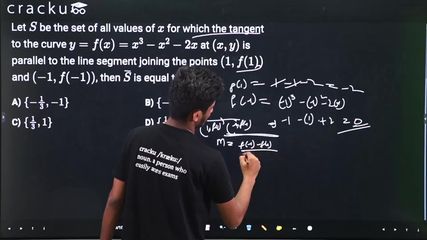
Click on the Email ☝️ to Watch the Video Solution
Create a FREE account and get:
_1.webp)

Educational materials for JEE preparation

Ask our AI anything

AI can make mistakes. Please verify important information.
AI can make mistakes. Please verify important information.
