
Join Our JEE Preparation Group
Prep with like-minded aspirants; Get access to free daily tests and study material.
Sign in
Please select an account to continue using cracku.in
↓ →
Join Our JEE Preparation Group
Prep with like-minded aspirants; Get access to free daily tests and study material.
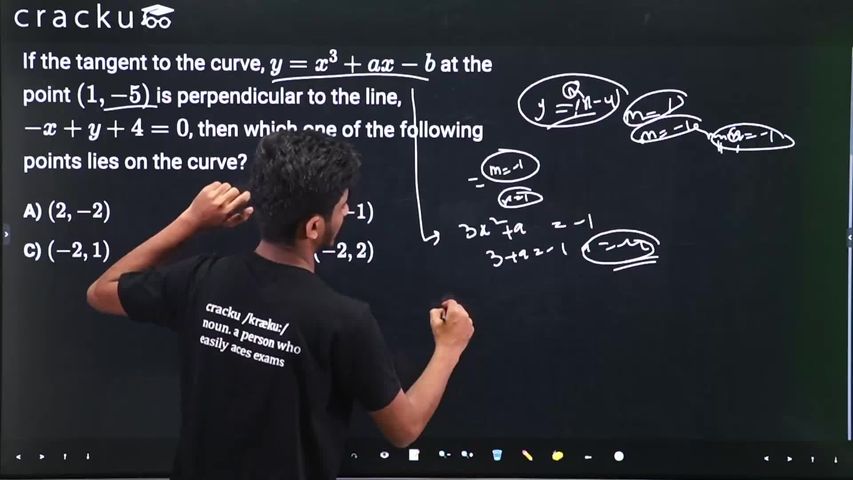
If the tangent to the curve, $$y = x^3 + ax - b$$ at the point $$(1, -5)$$ is perpendicular to the line, $$-x + y + 4 = 0$$, then which one of the following points lies on the curve?
We have the cubic curve $$y = x^3 + ax - b$$ and we know that its tangent at the point $$(1,-5)$$ is perpendicular to the straight line $$-x + y + 4 = 0.$$
First, let us rewrite the given straight line in the slope-intercept form. Adding $$x$$ to both sides gives
$$-x + y + 4 = 0 \;\;\Longrightarrow\;\; y = x - 4.$$
The general form $$y = mx + c$$ shows that the slope of this line is $$m = 1.$$
For two lines to be perpendicular, the product of their slopes must equal $$-1.$$ In other words, if one line has slope $$m_1$$, the line perpendicular to it has slope $$m_2$$ such that $$m_1 m_2 = -1.$$
Because the given line has slope $$1,$$ the slope of the required tangent must be
$$m_{\text{tangent}} = -\frac{1}{1} = -1.$$
The slope of the tangent to the curve $$y = x^3 + ax - b$$ at any point is obtained by differentiation. Using the rule $$\dfrac{d}{dx}(x^n) = nx^{\,n-1},$$ we get
$$\frac{dy}{dx} = 3x^2 + a.$$
At the point $$(1,-5),$$ we substitute $$x = 1$$ into the derivative:
$$m_{\text{tangent}} = 3(1)^2 + a = 3 + a.$$
But we have already found that this slope must equal $$-1.$$ Hence
$$3 + a = -1.$$
Subtracting $$3$$ from both sides, we arrive at
$$a = -4.$$
Now we use the fact that the point $$(1,-5)$$ lies on the curve. Substituting $$x = 1,\; y = -5,\; a = -4$$ into $$y = x^3 + ax - b,$$ we get
$$-5 = (1)^3 + (-4)(1) - b.$$
Simplifying the right-hand side step by step,
$$(1)^3 = 1,$$
$$( -4)(1) = -4,$$
so
$$-5 = 1 - 4 - b.$$
Combining $$1 - 4$$ gives $$-3,$$ hence
$$-5 = -3 - b.$$
Adding $$3$$ to both sides yields
$$-5 + 3 = -b \;\;\Longrightarrow\;\; -2 = -b.$$
Multiplying by $$-1$$, we find
$$b = 2.$$
Therefore the explicit equation of the curve becomes
$$y = x^3 - 4x - 2.$$
We now check which of the given options satisfies this equation.
Option A: $$(2,-2).$$
Substituting $$x = 2$$ gives
$$y = (2)^3 - 4(2) - 2 = 8 - 8 - 2 = -2.$$
The right-hand side indeed equals $$-2,$$ so the point $$(2,-2)$$ lies on the curve.
Option B: $$(2,-1).$$ The same calculation above shows the curve gives $$y = -2,$$ not $$-1,$$ so this point does not lie on the curve.
Option C: $$(-2,1).$$ Putting $$x = -2$$ gives
$$y = (-2)^3 - 4(-2) - 2 = -8 + 8 - 2 = -2,$$
which is not $$1.$$ Hence this point is not on the curve.
Option D: $$(-2,2).$$ The calculation above produced $$y = -2,$$ not $$2,$$ so this point is also not on the curve.
Only Option A satisfies the curve’s equation.
Hence, the correct answer is Option A.
Was this solution helpful?
Click on the Email ☝️ to Watch the Video Solution
Create a FREE account and get:
_1.webp)

Educational materials for JEE preparation

Ask our AI anything

AI can make mistakes. Please verify important information.
AI can make mistakes. Please verify important information.
