
Join Our JEE Preparation Group
Prep with like-minded aspirants; Get access to free daily tests and study material.
Sign in
Please select an account to continue using cracku.in
↓ →
Join Our JEE Preparation Group
Prep with like-minded aspirants; Get access to free daily tests and study material.
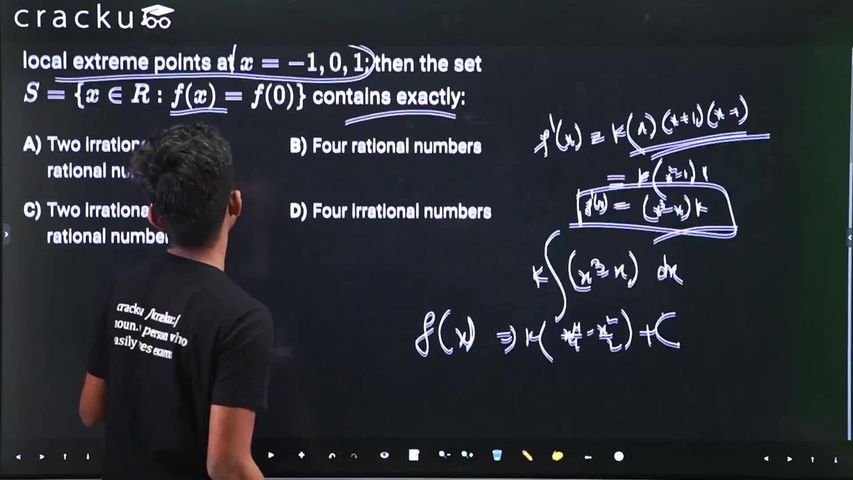
If $$f(x)$$ is a non-zero polynomial of degree four, having local extreme points at $$x = -1, 0, 1$$; then the set $$S = \{x \in R : f(x) = f(0)\}$$ contains exactly:
We are told that the polynomial $$f(x)$$ is of degree four and has local extreme points at $$x=-1,\;0,\;1$$. The definition of a local extremum says that the derivative of the function must vanish at each such point. Hence we must have
$$f'(-1)=0,\qquad f'(0)=0,\qquad f'(1)=0.$$
A polynomial of degree four has a derivative of degree three. Writing the derivative in its factored form, and because the three distinct real numbers $$-1,0,1$$ are all its zeros, we can state
$$f'(x)=k\,(x+1)\,x\,(x-1),$$
where $$k\neq0$$ is the leading-coefficient constant needed to match the unknown vertical scaling of the original quartic. Multiplying out the factors inside, we have
$$(x+1)\,x\,(x-1)=x\,(x^2-1)=x^3-x.$$
So the derivative simplifies to
$$f'(x)=k\,(x^3-x).$$
To recover $$f(x)$$ we integrate, remembering to add an integration constant. We use the elementary integration formulas $$\int x^n\,dx=\dfrac{x^{n+1}}{n+1}$$ and $$\int x\,dx=\dfrac{x^2}{2}$$. Thus:
$$
\begin{aligned}
f(x)&=\int f'(x)\,dx =\int k\,(x^3-x)\,dx \\
&=k\left(\int x^3\,dx-\int x\,dx\right) \\
&=k\left(\frac{x^4}{4}-\frac{x^2}{2}\right)+C,
\end{aligned}
$$
where $$C$$ is the constant of integration. Writing this compactly,
$$f(x)=\frac{k}{4}\bigl(x^4-2x^2\bigr)+C.$$
This expression indeed has degree four because $$k\neq0$$. Now we must solve the equation
$$f(x)=f(0)$$
and determine how many rational and irrational solutions it has. First, compute the value at $$x=0$$:
$$f(0)=\frac{k}{4}\bigl(0^4-2\cdot0^2\bigr)+C=C.$$
Setting $$f(x)=f(0)$$ therefore gives
$$\frac{k}{4}\bigl(x^4-2x^2\bigr)+C=C.$$
Subtract $$C$$ from both sides so the constants cancel:
$$\frac{k}{4}\bigl(x^4-2x^2\bigr)=0.$$
Because $$k\neq0$$, we can safely divide by $$\dfrac{k}{4}$$ (a non-zero number), leaving
$$x^4-2x^2=0.$$
We factor completely:
$$x^2\bigl(x^2-2\bigr)=0.$$
Now use the zero-product property, which states that if a product of factors equals zero then at least one factor must be zero. Thus we obtain two sub-equations:
$$x^2=0\quad\text{or}\quad x^2-2=0.$$
From $$x^2=0$$ we get the single solution
$$x=0.$$
From $$x^2-2=0$$ we get
$$x^2=2\quad\Longrightarrow\quad x=\pm\sqrt2.$$
Putting all roots together, the set
$$S=\{x\in\mathbb R:f(x)=f(0)\}$$
is
$$S=\{0,\;\sqrt2,\;-\sqrt2\}.$$
The element $$0$$ is a rational number, while $$\sqrt2$$ and $$-\sqrt2$$ are both irrational numbers. Therefore the set contains exactly two irrational numbers and one rational number.
Hence, the correct answer is Option C.
Was this solution helpful?
Click on the Email ☝️ to Watch the Video Solution
Create a FREE account and get:
_1.webp)

Educational materials for JEE preparation

Ask our AI anything

AI can make mistakes. Please verify important information.
AI can make mistakes. Please verify important information.
