
Join Our JEE Preparation Group
Prep with like-minded aspirants; Get access to free daily tests and study material.
Sign in
Please select an account to continue using cracku.in
↓ →
Join Our JEE Preparation Group
Prep with like-minded aspirants; Get access to free daily tests and study material.
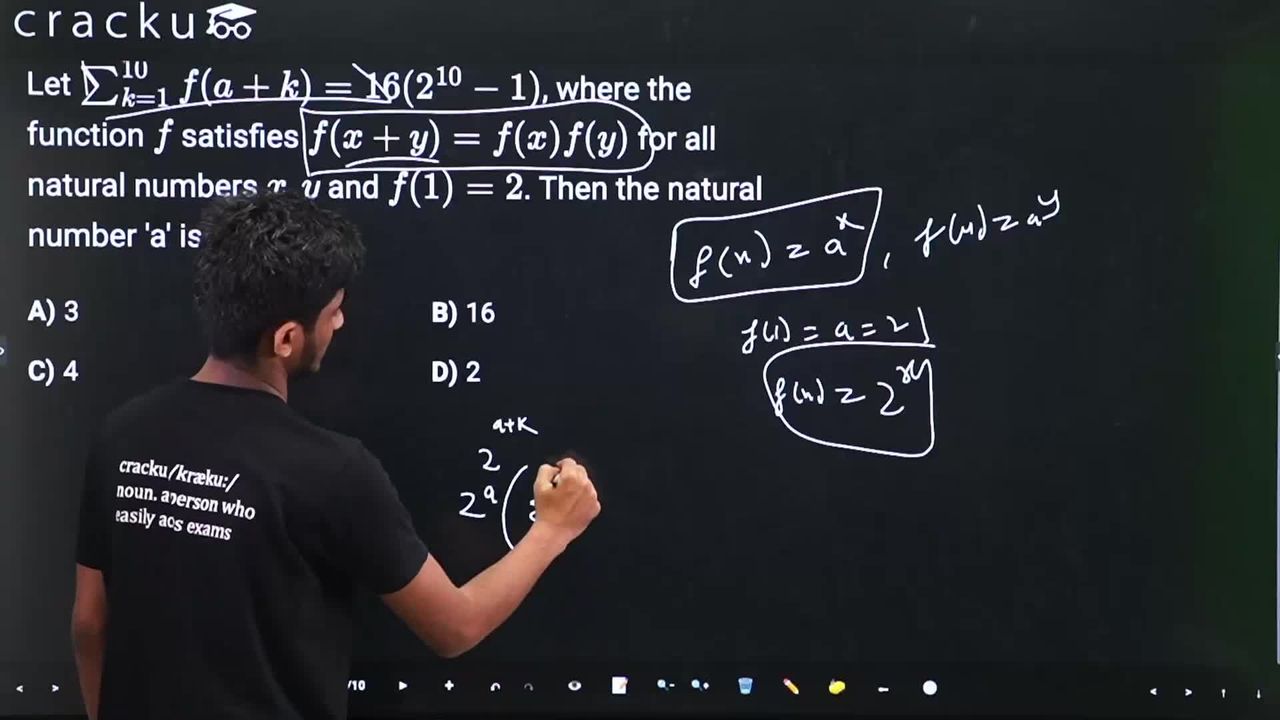
Let $$\sum_{k=1}^{10} f(a + k) = 16(2^{10} - 1)$$, where the function $$f$$ satisfies $$f(x + y) = f(x)f(y)$$ for all natural numbers $$x$$, $$y$$ and $$f(1) = 2$$. Then the natural number 'a' is:
We are given that the function $$f$$ satisfies the multiplicative rule $$f(x+y)=f(x)f(y)$$ for all natural numbers $$x$$ and $$y$$, and that $$f(1)=2$$.
First, we determine the explicit form of $$f(n)$$ for any natural number $$n$$. For $$n=1$$ we already have $$f(1)=2$$. Assume $$f(n)=2^{\,n}$$ is true for some $$n$$. Then
$$f(n+1)=f\bigl(n+1\bigr)=f(n)f(1)\; \text{(using the given property)}.$$
Substituting the induction hypothesis $$f(n)=2^{\,n}$$ and $$f(1)=2$$, we get
$$f(n+1)=2^{\,n}\times 2=2^{\,n+1}.$$
Thus, by mathematical induction, $$f(n)=2^{\,n}$$ for every natural number $$n$$.
Now we evaluate the given sum
$$\sum_{k=1}^{10} f(a+k)=\sum_{k=1}^{10} 2^{\,a+k}.$$
Factor out the common power $$2^{\,a}$$:
$$\sum_{k=1}^{10} 2^{\,a+k}=2^{\,a}\bigl(2^{\,1}+2^{\,2}+2^{\,3}+\cdots+2^{\,10}\bigr).$$
We recognize the bracketed expression as a finite geometric progression with first term $$2$$, common ratio $$2$$ and number of terms $$10$$. The sum of a geometric progression with first term $$A$$, ratio $$r$$ and $$n$$ terms is given by
$$S_n=\dfrac{A(r^{\,n}-1)}{r-1}.$$
Here $$A=2$$, $$r=2$$, $$n=10$$, so
$$2^{\,1}+2^{\,2}+\cdots+2^{\,10}=2\left(2^{\,10}-1\right).$$
Substituting this back, we have
$$\sum_{k=1}^{10} f(a+k)=2^{\,a}\times 2\left(2^{\,10}-1\right)=2^{\,a+1}\left(2^{\,10}-1\right).$$
According to the question, this equals $$16\bigl(2^{\,10}-1\bigr)$$. Observe that $$16=2^{\,4}$$, so the given equality becomes
$$2^{\,a+1}\left(2^{\,10}-1\right)=2^{\,4}\left(2^{\,10}-1\right).$$
The factor $$2^{\,10}-1$$ is common and non-zero, so we can cancel it, giving
$$2^{\,a+1}=2^{\,4}.$$
Since the bases are equal and positive, their exponents must be equal:
$$a+1=4 \;\;\Longrightarrow\;\; a=3.$$
Hence, the correct answer is Option A.
Was this solution helpful?
Click on the Email ☝️ to Watch the Video Solution
Create a FREE account and get:
_1.webp)

Educational materials for JEE preparation

Ask our AI anything

AI can make mistakes. Please verify important information.
AI can make mistakes. Please verify important information.
