
Join Our JEE Preparation Group
Prep with like-minded aspirants; Get access to free daily tests and study material.
Sign in
Please select an account to continue using cracku.in
↓ →
Join Our JEE Preparation Group
Prep with like-minded aspirants; Get access to free daily tests and study material.
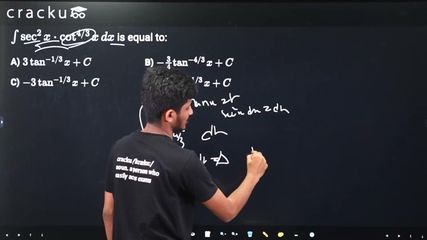
$$\int \sec^2 x \cdot \cot^{4/3} x \, dx$$ is equal to:
We need to evaluate the integral $$\displaystyle\int \sec^2 x \,\cot^{4/3}x \,dx.$$
First, recall the basic trigonometric identities
$$\cot x=\frac{1}{\tan x}\qquad\text{and hence}\qquad\cot^{4/3}x=\left(\frac{1}{\tan x}\right)^{4/3}=\tan^{-4/3}x.$$
Using this in the integrand we have
$$\int \sec^2 x \,\cot^{4/3}x \,dx=\int \sec^2 x \,\tan^{-4/3}x \,dx.$$
Now we notice the derivative formula $$\dfrac{d}{dx}\tan x=\sec^2 x.$$ This suggests the substitution
$$t=\tan x \quad\Longrightarrow\quad dt=\sec^2 x\,dx.$$
Because $$\sec^2 x \,dx=dt,$$ the entire differential part of the integral is replaced by $$dt$$. Substituting, we get
$$\int \sec^2 x \,\tan^{-4/3}x \,dx=\int t^{-4/3}\,dt.$$
We now integrate the power of $$t$$. For any exponent $$n\neq -1$$, the formula is $$\displaystyle\int t^{\,n}\,dt=\frac{t^{\,n+1}}{n+1}+C.$$ Here $$n=-\dfrac{4}{3}$$, so $$n+1=-\dfrac{4}{3}+1=-\dfrac{1}{3}.$$ Applying the formula,
$$\int t^{-4/3}\,dt=\frac{t^{-1/3}}{-1/3}+C.$$
Simplifying the fraction $$\dfrac{1}{-1/3}=-3,$$ we obtain
$$\frac{t^{-1/3}}{-1/3}+C=-3\,t^{-1/3}+C.$$
Finally, we substitute back $$t=\tan x$$ to return to the original variable:
$$-3\,t^{-1/3}+C=-3\,\tan^{-1/3}x+C.$$
Hence, the correct answer is Option C.
Was this solution helpful?
Click on the Email ☝️ to Watch the Video Solution
Create a FREE account and get:
_1.webp)

Educational materials for JEE preparation

Ask our AI anything

AI can make mistakes. Please verify important information.
AI can make mistakes. Please verify important information.
