
Join Our JEE Preparation Group
Prep with like-minded aspirants; Get access to free daily tests and study material.
Sign in
Please select an account to continue using cracku.in
↓ →
Join Our JEE Preparation Group
Prep with like-minded aspirants; Get access to free daily tests and study material.
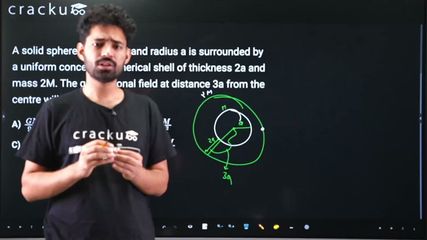
A solid sphere of mass M and radius a is surrounded by a uniform concentric spherical shell of thickness 2a and mass 2M. The gravitational field at distance 3a from the centre will be:
Let us denote the centre of both the solid sphere and the surrounding shell by $$O$$. The given data are:
• Solid sphere: mass $$M$$, radius $$a$$.
• Concentric spherical shell: inner radius $$a$$, outer radius $$(a+2a)=3a$$, mass $$2M$$, uniform mass distribution.
We want the gravitational field (its magnitude) at a point situated at a distance $$r=3a$$ from the centre, i.e. at the outer surface of the shell.
First, recall the basic result for spherically symmetric mass distributions:
Statement of the theorem — For any point lying outside a spherically symmetric mass distribution (or exactly on its outer surface), the gravitational field is the same as if the entire mass were concentrated at the centre.
Here the point of interest is on the outer surface, so the above theorem applies. Therefore, we may replace the complete two-part body by a single point mass at the centre whose value equals the total mass enclosed within radius $$3a$$.
Now compute that total mass:
$$M_{\text{total}} = \text{mass of solid sphere} + \text{mass of shell} = M + 2M = 3M.$$
Using Newton’s law for the magnitude of gravitational field $$g$$ produced by a point mass $$M_{\text{total}}$$ at a distance $$r$$,
$$g = \frac{G\,M_{\text{total}}}{r^{2}},$$
where $$G$$ is the universal gravitational constant.
Substituting $$M_{\text{total}} = 3M$$ and $$r = 3a$$ gives
$$g = \frac{G \,(3M)}{(3a)^{2}} = \frac{3GM}{9a^{2}} = \frac{GM}{3a^{2}}.$$
Hence, the correct answer is Option B.
Was this solution helpful?
Click on the Email ☝️ to Watch the Video Solution
Create a FREE account and get:
_1.webp)

Educational materials for JEE preparation

Ask our AI anything

AI can make mistakes. Please verify important information.
AI can make mistakes. Please verify important information.
