
Join Our JEE Preparation Group
Prep with like-minded aspirants; Get access to free daily tests and study material.
Sign in
Please select an account to continue using cracku.in
↓ →
Join Our JEE Preparation Group
Prep with like-minded aspirants; Get access to free daily tests and study material.
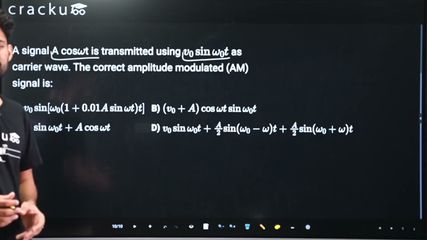
A signal A cos$$\omega$$t is transmitted using $$v_0 \sin\omega_0 t$$ as carrier wave. The correct amplitude modulated (AM) signal is:
We begin by recalling what happens in ordinary (double-sideband) amplitude modulation. The instantaneous value of the carrier wave $$v_{\text{c}}(t)$$ is multiplied by a slowly varying factor that contains the information (the “message” or “signal”). Mathematically, if the carrier is $$v_0\sin\omega_0t$$ and the signal is $$A\cos\omega t,$$ the standard AM formula is stated as
$$ \text{AM signal}= \bigl[v_0 + A\cos\omega t\bigr]\sin\omega_0t. $$
Here $$v_0$$ is the unmodulated carrier amplitude, $$\omega_0$$ is the carrier’s angular frequency, $$A$$ is the peak value of the message, and $$\omega$$ is the message (modulating) angular frequency. The term $$v_0 + A\cos\omega t$$ makes the carrier’s amplitude rise and fall in step with the information contained in $$A\cos\omega t.$$
Now we expand the product to see the separate frequency components. Keeping every algebraic step visible, we write
$$ \bigl[v_0 + A\cos\omega t\bigr]\sin\omega_0t = v_0\sin\omega_0t \;+\; A\cos\omega t\,\sin\omega_0t. $$
The first term $$v_0\sin\omega_0t$$ is simply the original carrier; the second term contains the sidebands. To simplify the mixed product in the second term we invoke the well-known trigonometric identity, which we state explicitly:
Formula: $$\sin B \,\cos C \;=\;\tfrac12\bigl[\sin(B+C) + \sin(B-C)\bigr].$$
Substituting $$B=\omega_0t$$ and $$C=\omega t$$ gives
$$ \cos\omega t\,\sin\omega_0t = \tfrac12\bigl[\sin(\omega_0+\omega)t + \sin(\omega_0-\omega)t\bigr]. $$
Multiplying by the coefficient $$A$$ and putting everything together, we obtain
$$ v_0\sin\omega_0t \;+\; A\cos\omega t\,\sin\omega_0t \;=\; v_0\sin\omega_0t \;+\; \frac{A}{2}\sin(\omega_0+\omega)t \;+\; \frac{A}{2}\sin(\omega_0-\omega)t. $$
This final expression shows the carrier at frequency $$\omega_0$$ and two sidebands at the sum and difference frequencies $$\omega_0+\omega$$ and $$\omega_0-\omega,$$ exactly as an AM wave should. Comparing with the given options, we see that Option D matches term-for-term:
$$ v_0 \sin\omega_0 t\;+\;\frac{A}{2}\sin(\omega_0-\omega)t\;+\;\frac{A}{2}\sin(\omega_0+\omega)t. $$
Hence, the correct answer is Option D.
Was this solution helpful?
Click on the Email ☝️ to Watch the Video Solution
Create a FREE account and get:
_1.webp)

Educational materials for JEE preparation

Ask our AI anything

AI can make mistakes. Please verify important information.
AI can make mistakes. Please verify important information.
