
Join Our JEE Preparation Group
Prep with like-minded aspirants; Get access to free daily tests and study material.
Sign in
Please select an account to continue using cracku.in
↓ →
Join Our JEE Preparation Group
Prep with like-minded aspirants; Get access to free daily tests and study material.
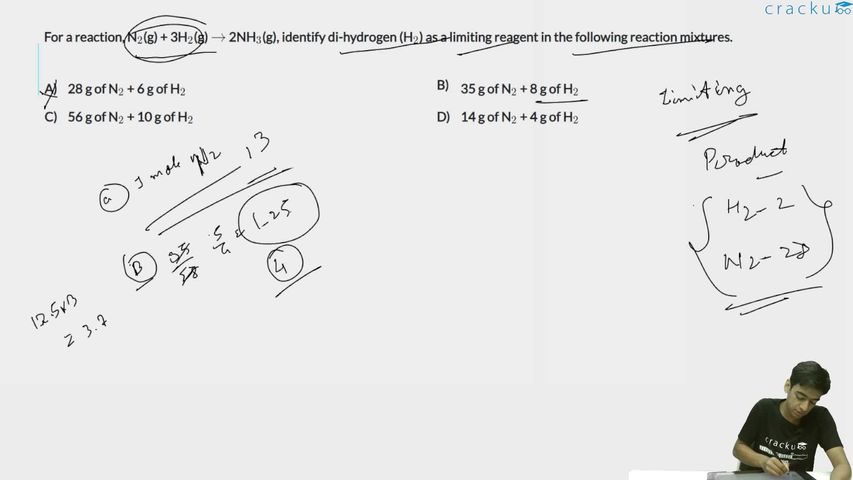
For a reaction, N$$_2$$(g) + 3H$$_2$$(g) $$\rightarrow$$ 2NH$$_3$$(g), identify di-hydrogen (H$$_2$$) as a limiting reagent in the following reaction mixtures.
We have the balanced chemical equation
$$\mathrm{N_2(g)\;+\;3H_2(g)\;\rightarrow\;2NH_3(g)}$$
This tells us that for every $$1$$ mole of di-nitrogen, exactly $$3$$ moles of di-hydrogen are required. In other words, the stoichiometric (required) mole ratio is $$\displaystyle\frac{n(H_2)}{n(N_2)}=3:1$$.
To discover the limiting reagent we first convert each given mass to moles by using the formula
$$n=\frac{\text{mass}}{\text{molar mass}}.$$
The molar masses are $$M(N_2)=28\;\text{g mol}^{-1}$$ and $$M(H_2)=2\;\text{g mol}^{-1}.$$
Option A 28 g $$N_2$$ and 6 g $$H_2$$
$$n(N_2)=\frac{28}{28}=1\text{ mol},\qquad n(H_2)=\frac{6}{2}=3\text{ mol}.$$
Required moles of $$H_2$$ for 1 mol $$N_2$$ are $$1\times3=3\text{ mol}.$$ Available moles of $$H_2$$ are also 3 mol, so the mixture is exactly stoichiometric. Therefore neither reactant limits the reaction and $$H_2$$ is not the limiting reagent.
Option B 35 g $$N_2$$ and 8 g $$H_2$$
$$n(N_2)=\frac{35}{28}=1.25\text{ mol},\qquad n(H_2)=\frac{8}{2}=4\text{ mol}.$$
Required moles of $$H_2$$ for 1.25 mol $$N_2$$ are $$1.25\times3=3.75\text{ mol}.$$ Available moles of $$H_2$$ are 4 mol, i.e. more than required, so $$N_2$$ is limiting and $$H_2$$ is in excess.
Option C 56 g $$N_2$$ and 10 g $$H_2$$
$$n(N_2)=\frac{56}{28}=2\text{ mol},\qquad n(H_2)=\frac{10}{2}=5\text{ mol}.$$
Required moles of $$H_2$$ for 2 mol $$N_2$$ are $$2\times3=6\text{ mol}.$$ Available moles of $$H_2$$ are only 5 mol, which is less than the 6 mol needed. Hence $$H_2$$ will be consumed first and is the limiting reagent in this mixture.
Option D 14 g $$N_2$$ and 4 g $$H_2$$
$$n(N_2)=\frac{14}{28}=0.5\text{ mol},\qquad n(H_2)=\frac{4}{2}=2\text{ mol}.$$
Required moles of $$H_2$$ for 0.5 mol $$N_2$$ are $$0.5\times3=1.5\text{ mol}.$$ Available moles of $$H_2$$ are 2 mol, i.e. more than required, so $$N_2$$ is limiting and $$H_2$$ is in excess.
From the detailed mole calculations we see that di-hydrogen acts as the limiting reagent only in Option C.
Hence, the correct answer is Option C.
Was this solution helpful?
Click on the Email ☝️ to Watch the Video Solution
Create a FREE account and get:
_1.webp)

Educational materials for JEE preparation

Ask our AI anything

AI can make mistakes. Please verify important information.
AI can make mistakes. Please verify important information.
